


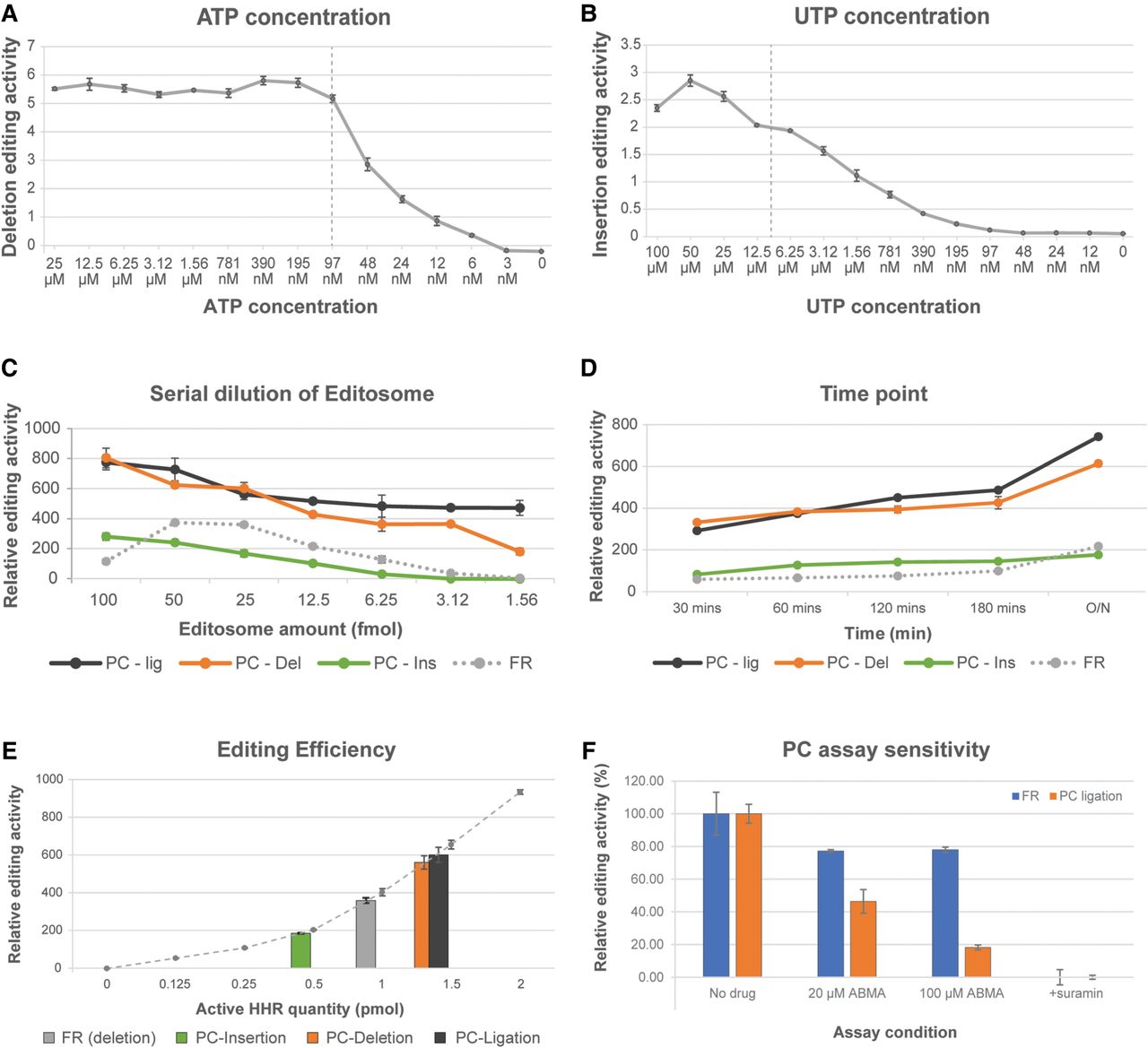
Optimized conditions for efficient editing in the precleaved assays. Varying concentrations of (A) ATP and (B) UTP substrates in the PC-deletion and insertion assays, respectively. (C) Relative RNA editing activities of different amounts of functional editosome in the PC-insertion, deletion, ligation, and the full-round assay. (D) Timepoint measurement of editing activities in the PC-insertion, deletion, ligation, and the conventional full-round assay. (E) Editing efficiencies of the different assays against a standard plot of active HHR. Each bar represents an editing assay and the corresponding activity of their edited product. (F) an ATP analog (α, β-methylene ATP) was used to compare the sensitivity of the ligation assay with a full-round assay to find competitive inhibitors. There was no difference between editing activity in the full round assay in the presence of 20 µM versus 100 µM ABMA (P > 0.05), but the ligation assay inhibition was significant (P < 0.05), calculated by one-way ANOVA (GraphPad Prism). Means and standard deviations in all six plots were calculated and are shown for at least two replicates.




