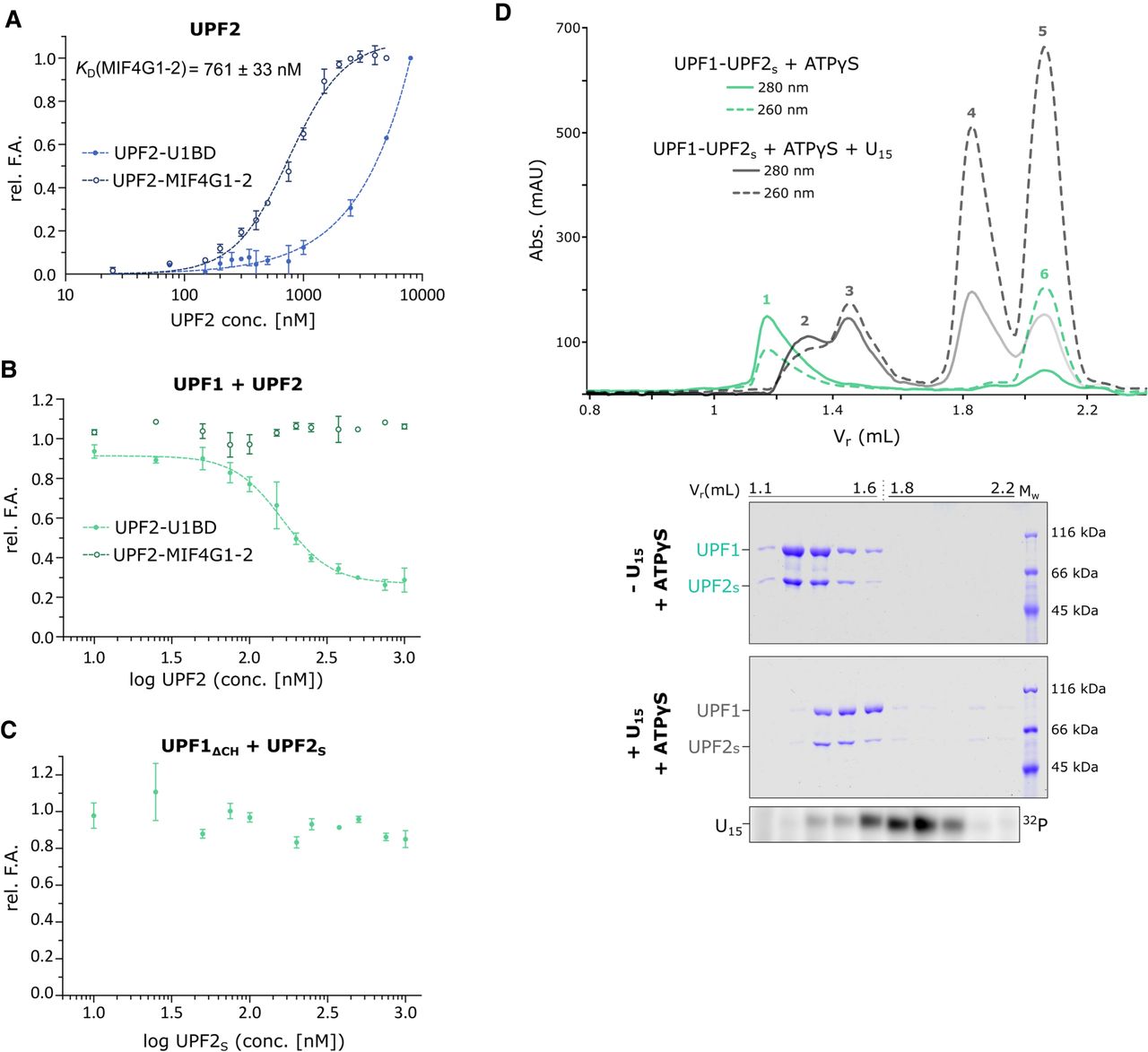
Displacement of UPF1 from RNA by UPF2 is not due to competition in RNA binding. (A) Quantitative measurements of RNA-binding affinities of UPF2 constructs comprising (UPF2–U1BD) and lacking the UPF1-binding site (UPF2-MIF4G1-2) by fluorescence anisotropy using 6-FAM-labeled U12 RNA. The KD of UPF2-MIF4G1-2 is reported along with its SD. The affinity of UPF2-MIF4G1-2 (open circles) for RNA is comparable to that of UPF2S, whereas UPF2–U1BD (filled circles) does not show any appreciable affinity for RNA. (B) Fluorescence anisotropy competition assays to determine the effect of UPF2–U1BD and UPF2-MIF4G1-2 on the UPF1–RNA interaction. The UPF2–U1BD protein that binds UPF1, but not RNA, is capable of displacing UPF1 from RNA (filled circles), whereas the MIF4G1-2 construct that binds RNA but lacks the UPF1-binding motif has no impact on RNA binding by UPF1 (open circles). (C) Fluorescence anisotropy competition assay of UPF1ΔCH with UPF2S. UPF2 has no effect on RNA binding by UPF1ΔCH, consistent with its inability to bind a UPF1 construct lacking the CH domain. (D) Analytical SEC analysis of a mixture of a UPF1–UPF2S complex, ATPγS and U15 RNA. (Top) Overlay of chromatograms of a mixture of the preformed UPF1–UPF2S complex and ATPγS, without (green traces) and with U15 RNA (black traces). (Bottom) SDS- and urea-PAGE analyses of consecutive SEC fractions in order of increasing retention volume, as indicated. Detection of U15 RNA is as described in Figure 1. Addition of RNA to UPF1–UPF2S leads to partial dissociation of the protein complex even in the presence of a nucleotide. The peaks between 1.8 and 2 mL correspond to excess U15 RNA and ATPγS.