


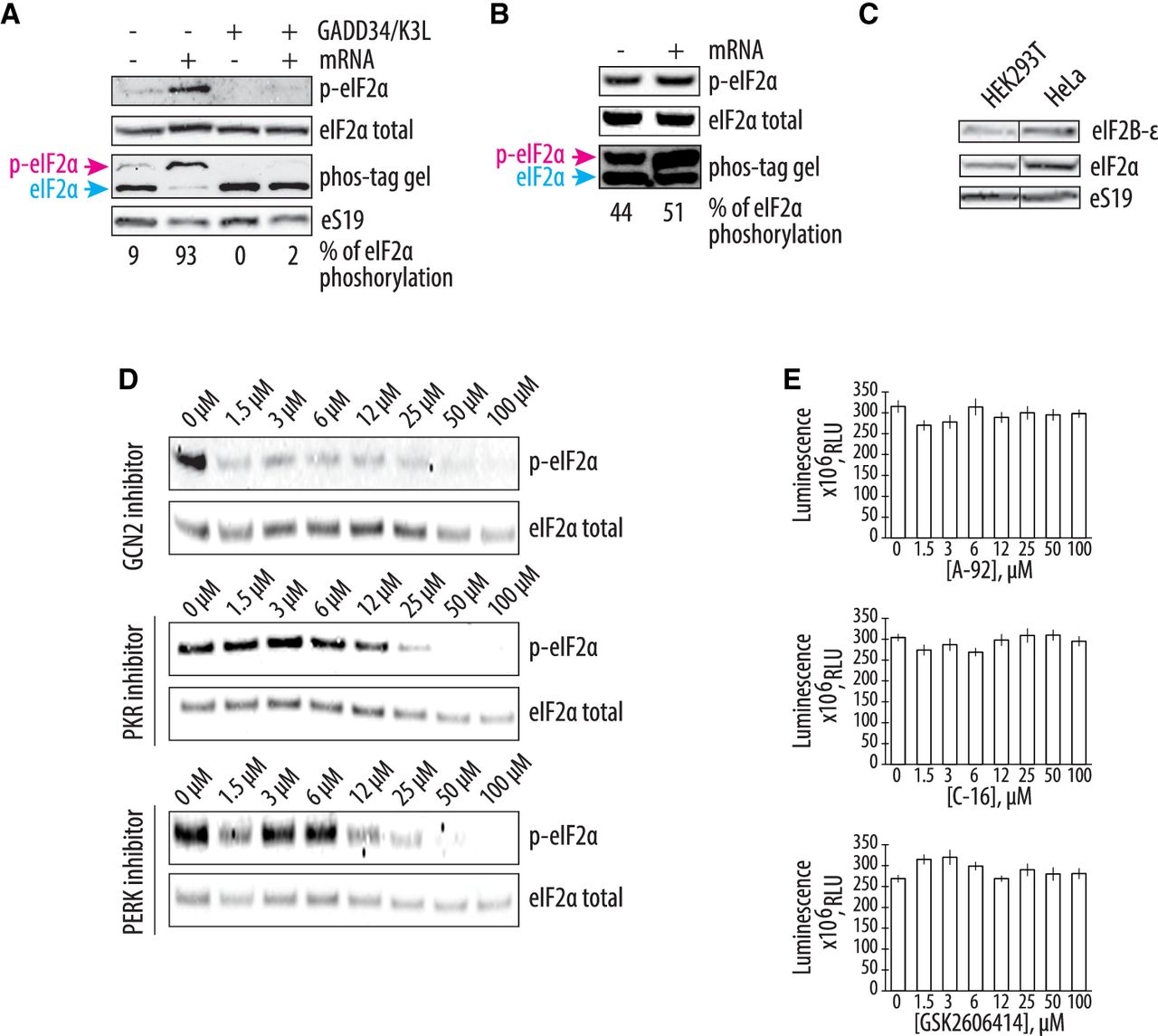
GCN2 kinase is responsible for the residual phosphorylation of eIF2α during CFPS in the engineered HEK293T extract. (A) Western blots for phosphorylation of eIF2α in the HEK293T-based CFPS systems with and without GADD34Δ and K3L expression. The uncapped EMCV IRES-containing polyadenylated mRNA was used to drive the synthesis of nLuc. (B) Induction of eIF2α phosphorylation in the HeLa-based commercial translation system supplemented with the same mRNA. For both A and B, the blue arrow indicates the nonphosphorylated form of the eIF2α, while the magenta arrow indicates the phosphorylated form on the Phos-tag gels. The western blots above the Phos-tag gels used normal SDS–PAGE gels sequentially blotted with anti-eIF2α and anti-P-Ser51 eIF2α antibodies. For both A and B, the gels are representative of two independent experiments. The percentage of eIF2α phosphorylation, based on the Phos-tag gels, is indicated under the gels (see Materials and Methods). (C) Western blot showing the amount of the eIF2B-ε and eIF2α in the HEK293T and HeLa cellular extracts. The gel is representative of two independent experiments. (D) The GCN2 but not PKR or PERK kinase inhibitor protects eIF2α from phosphorylation during CFPS. The compound A-92 (Brazeau and Rosse 2014) was used as a GCN2 kinase inhibitor, C-16 (Jammi et al. 2003) for PKR kinase inhibition, and GSK2606414 (Axten et al. 2012) as an inhibitor of PERK kinase. The concentrations of the eIF2α-specific kinase inhibitors are indicated. Gels are representative of two independent experiments. (E) Cell-free synthesis of nLuc in different concentrations of the eIF2α-specific kinase inhibitors. All error bars represent one standard deviation of three independent replicates.




