


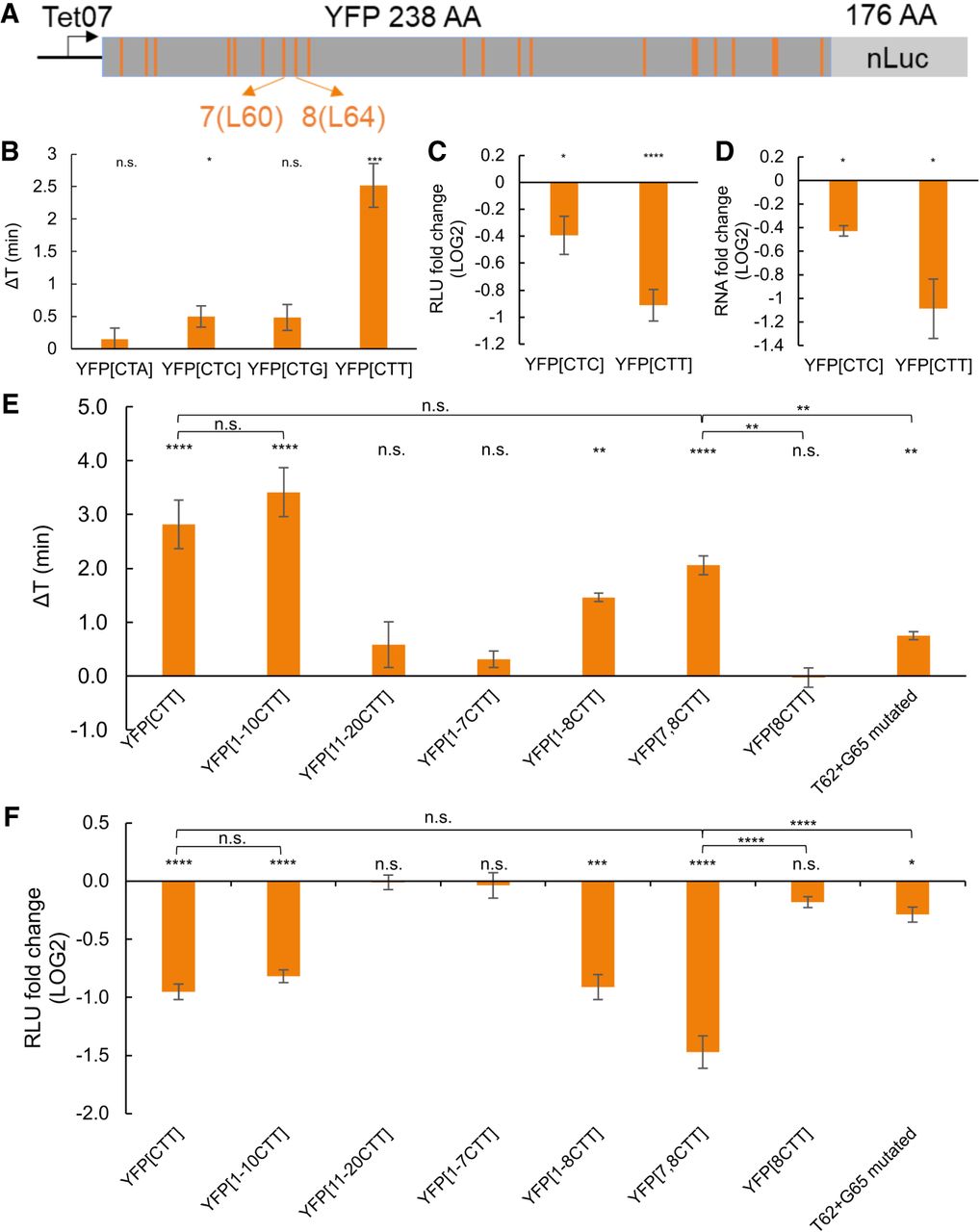
Distributed stalls in the YFP ORF decrease protein expression, mRNA levels, and delays elongation time. (A) Diagram of synonymously substituted leucine constructs. YFP contains 21 leucine codons which are marked in orange. The first 20 leucine codons are substituted for a nonoptimal leucine variant, and the 21st leucine remains the optimal TTG codon. No. 7 and no. 8 leucines from the 5′end of YFP ORF are labeled as L60 and L64. (B) Elongation delay of distributed stall constructs compared to optYFP (YFP[CTA] n = 6, YFP[CTC] n = 6, YFP[CTG] n = 5, YFP[CTT] n = 7). The first 20 out of 21 total optimal TTG leucine codons in optYFP are synonymously substituted to a nonoptimal codon specified in brackets. (C) Protein expression of distributed stall constructs normalized to optYFP control (n = 4 for all). (D) mRNA levels of distributed stall constructs normalized to optYFP control (n = 3 for all). (E) Elongation delay measurements of chimeric constructs normalized to optYFP control (n = 3 for YFP[1–7CTT], YFP[1–8CTT], YFP[8CTT], and T62 + G65 mutated constructs, n = 5 for YFP[1–10CTT] and YFP[11–20CTT], n = 11 for YFP[CTT], n = 12 for YFP[7,8CTT]). (F) Protein expression chimeric constructs normalized to optYFP control (n = 3 for YFP[1–7CTT], YFP[1–8CTT], YFP[8CTT], and T62 + G65 mutated constructs, n = 5 for YFP[1–10CTT] and YFP[11–20CTT], n = 11 for YFP[CTT], n = 12 for YFP[7,8CTT]). All error bars indicate SEM. All statistical significances were calculated for each construct using two-tailed paired Student's t-test against optYFP control unless otherwise specified.




