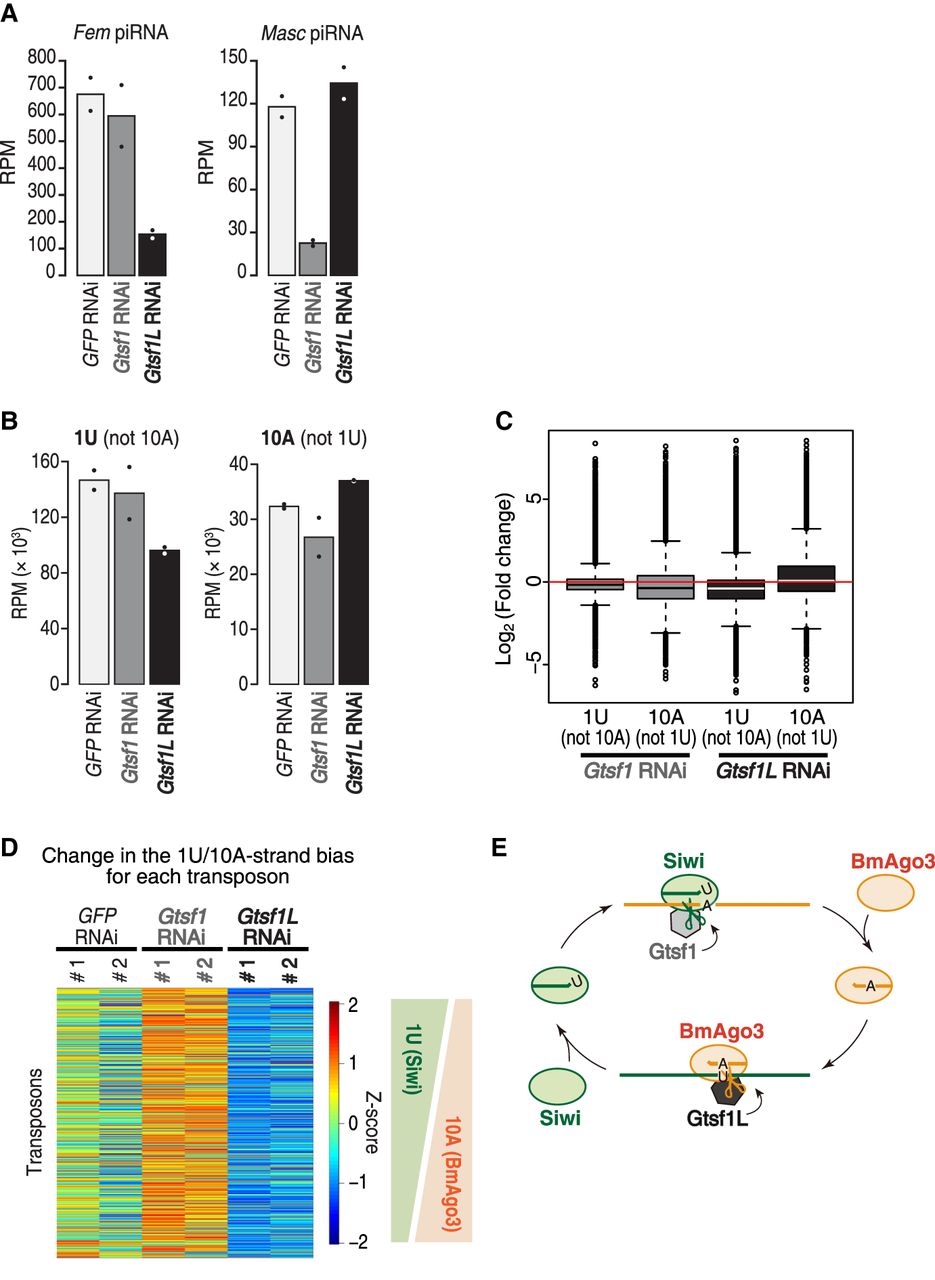
Gtsf1 and Gtsf1L separately function in the ping-pong cycle in vivo. (A) The expression of Fem and Masc piRNAs in silkworm embryos injected with siRNAs for GFP (control), Gtsf1 or Gtsf1L. The values are means of two biological replicates. Dots, individual values. (B) Normalized reads of 1U (but not 10A) or 10A (but not 1U) small RNA from silkworm embryos injected with siRNAs for GFP (control), Gtsf1 or Gtsf1L. The values are means of two biological replicates. Dots, individual values. (C) Box plots showing the expression change of 1U (but not 10A) and 10A (but not 1U) piRNAs by knockdown of Gtsf1or Gtsf1L relative to GFP (control) knockdown in embryos. Center line, median; box limits, upper and lower quartiles; whiskers, 1.5 × interquartile range; points, outliers. (D) Heatmap representation of relative changes in the 1U/10A strand bias between six samples for each transposon. The 1U/10A strand bias tends to increase (i.e., relative reduction of 10A-biased BmAgo3 piRNA) and decrease (i.e., relative reduction of 1U-biased Siwi piRNA) in Gtsf1- and Gtsf1L-knockdown, respectively. Two biological replicates per each knockdown condition. (E) A model for the role of two silkworm Gtsf proteins in the ping-pong cycle. Gtsf1 and Gtsf1L contribute to the production of BmAgo3- and Siwi-piRNAs by facilitating target cleavage of Siwi and BmAgo3, respectively.