


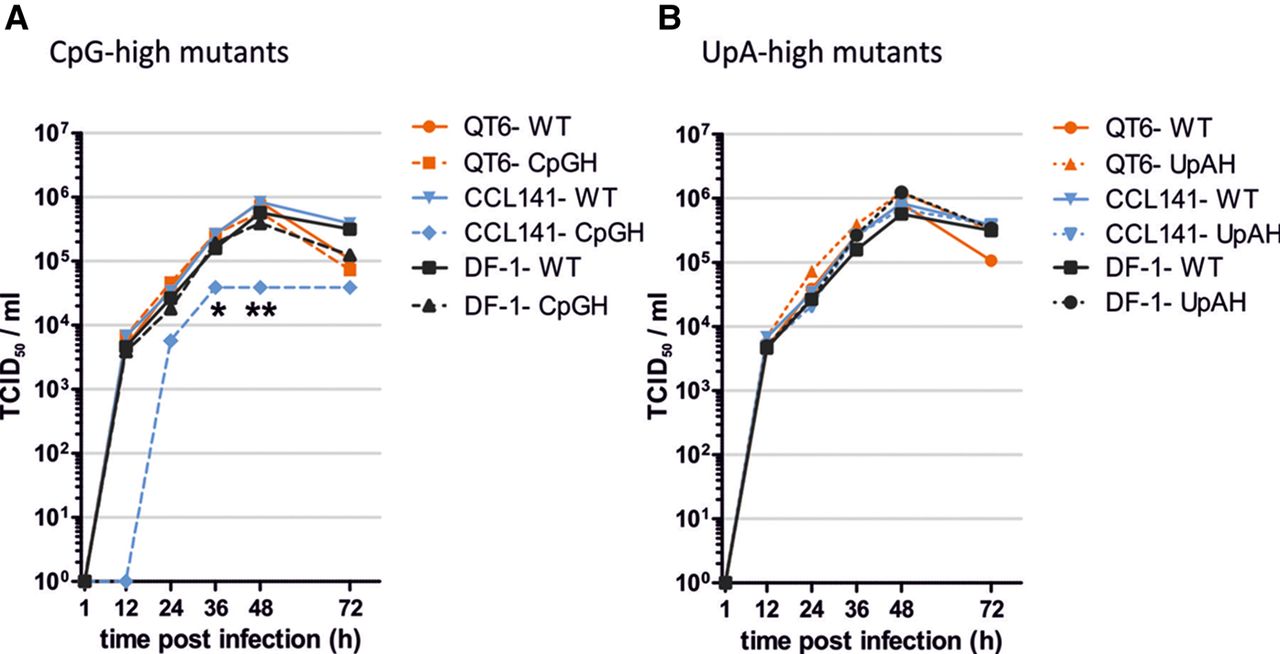
Comparison of the replication kinetics of WT IAV with mutants with elevated (A) CpG and (B) UpA dinucleotide frequencies in segment 4. Replication was assayed in mutants in the avian cell lines QT6 (Japanese Quail fibrosarcoma—Coturnix japonica), DF-1 (chicken embryo fibroblast—Gallus gallus) and CCL-141 (duck embryo—Anas platyrhynchos). Cells were infected at an MOI of 0.001, and at specified times supernatant was collected and titrated by infectivity using A549 ZAP k/o cells—TCID50 values shown on the y-axis. Data points represent the mean of two biological replicates; the reduced replication in the replication of the CpG-H compared to WT was significant in unpaired value t-test at 24 h and 36 h time points, (*) P = 0.03, (**) P = 0.04, and by two-way ANOVA (P = 0.022). No other comparisons of mutant (CpG-H or UpA-H) or time point with WT were significant at the P = 0.05 level.




