


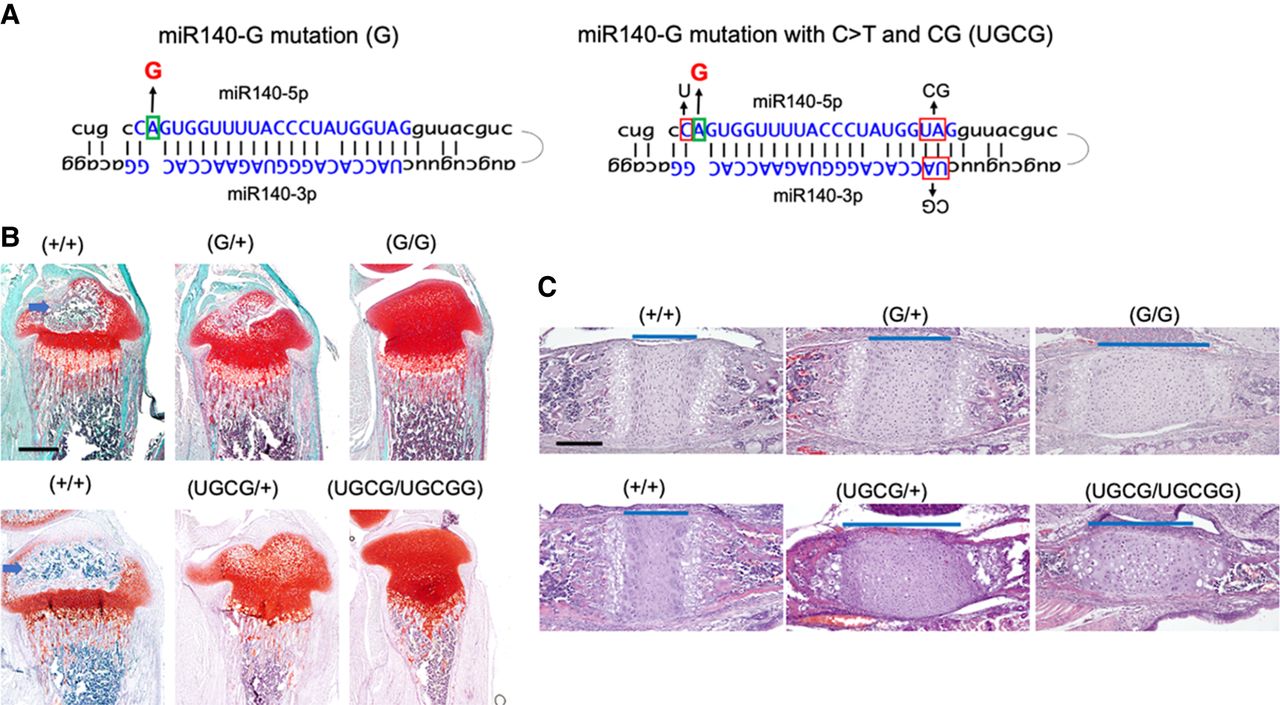
A gain-of-mutation in the C > T and CG context enhances the phenotype. (A) A gain-of-function (GOF) mutation at the second nucleotide of miR-140-5p (A > G) (G) was combined with C > T and CG mutation (UGCG). (B,C) Safranin O-stained tibial sections of P14 mice (B) and hematoxylin and eosin-stained spheno-occipital growth plates in the basal skull of P7 mice (C) with following genotypes: wild-type control (+/+), heterozygous (G/+) and homozygous (G/G) GOF mutant, and heterozygous (UGCG/+) and homozygous (UGCG/UGCG) GOF with C > T and CG mutant. The A > G mutation delays epiphyseal development, as the entire epiphysis is still mostly occupied by Safranin O-positive cartilage matrix in mutant mice, whereas bone tissue (blue arrows) has already replaced a major part of the cartilage in wild-type littermates (B) and causes an expansion of proliferating chondrocytes (blue lines in C). Additional UGCG mutations cause greater changes in the heterozygous state. Note the extent of expansion of the spheno-occipital growth plate of (UGCG/+) mice is greater than that of (G/+) mice and comparable to that of (UGCG/+) mice. Scale bars: 500 µm (B); 200 µm (C).




