


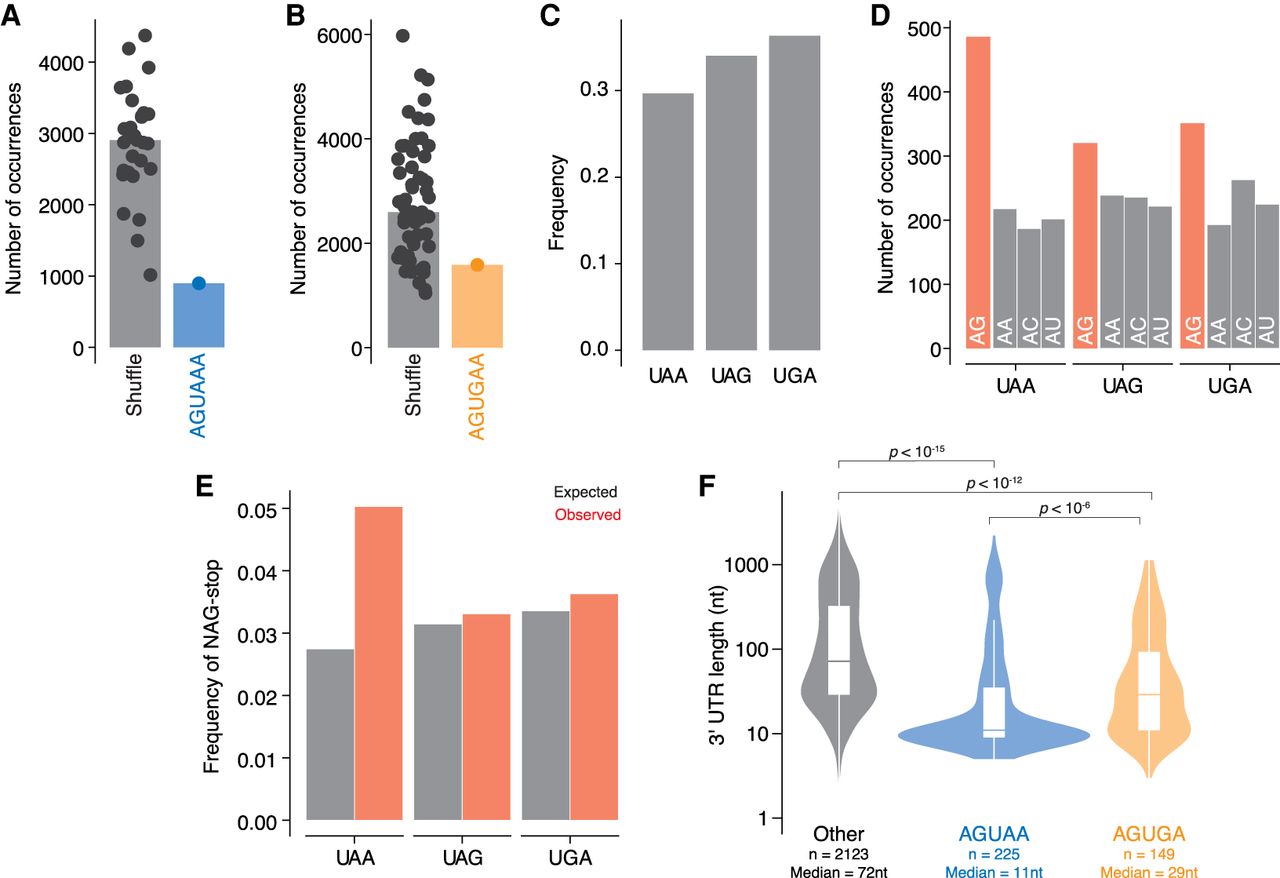
Implications of unusual poly(A) signal on G. lamblia open reading frames. (A) Open reading frames are depleted for G. lamblia's poly(A) signal. Open reading frame sequences were used to count the occurrence of AGUAAA vs all shuffled versions of the motif. (B) As in A, but with the AGUGAA poly(A) signal. (C) Frequency of stop codons across all annotated G. lamblia open reading frames. (D) Nucleotides preceding a stop are enriched for AG over other AN dinucleotides. For each stop codon, this bar graph shows how many were preceded by the different AN dinucleotide sequences. (E) As in D, but comparing expected versus observed frequencies. The expected frequency for each sequence context was calculated from the total frequency of each codon across all open reading frames. (F) Distribution of 3′ UTR lengths for genes where there is no overlap of poly(A) signal and stop codon (left), genes where there is an AG dinucleotide preceding a UAA stop codon (middle), and genes where there is an AG preceding a UGA stop codon (right).




