


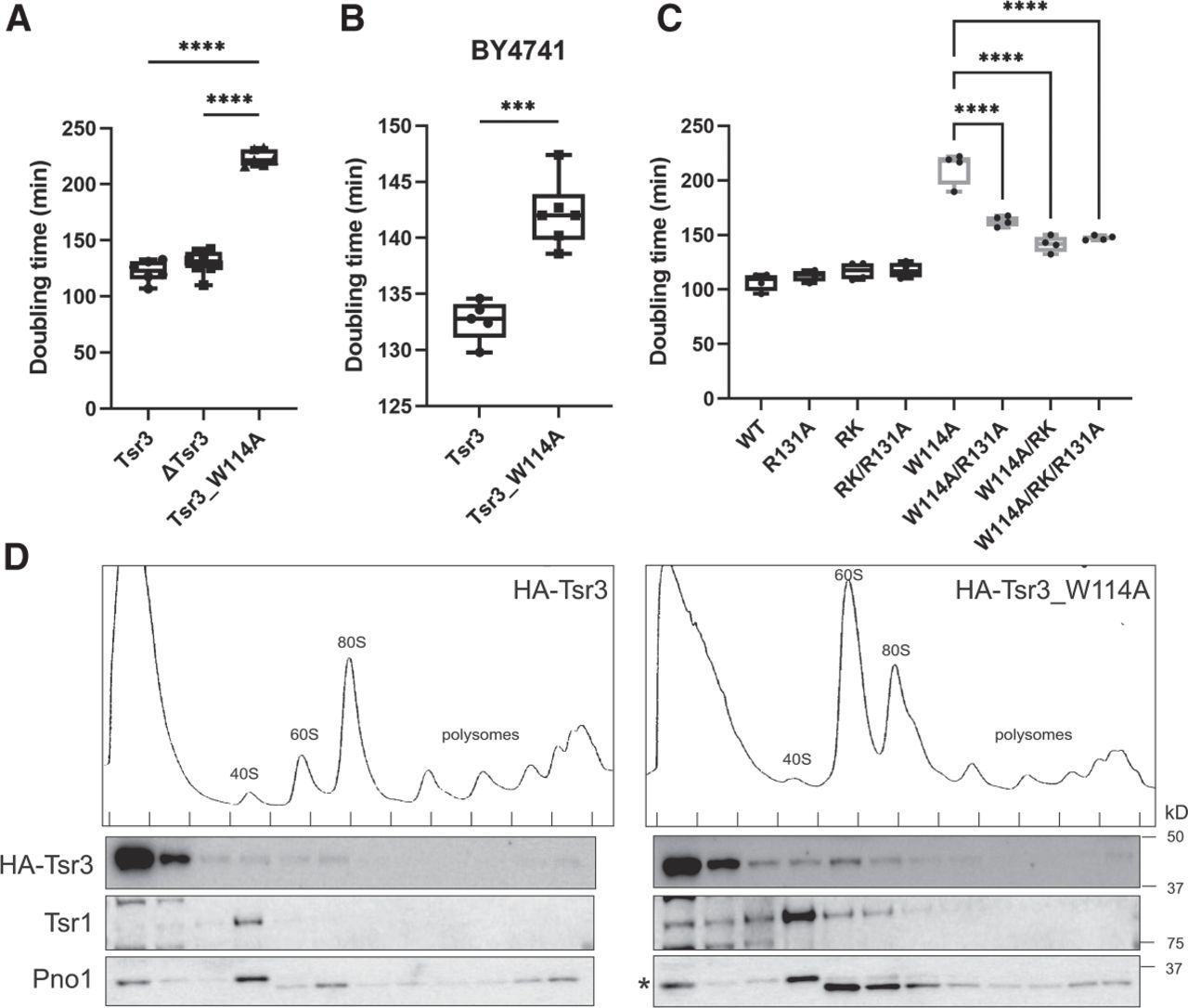
The acp modification activity of Tsr3 is required for its release. (A) Doubling times of ΔTsr3 cells supplemented with a plasmid encoding WT Tsr3 (Tsr3), an empty vector (ΔTsr3), or a plasmid encoding Tsr3_W114A (Tsr3_W114A). Significance was tested using one-way ANOVA (Sidak's multiple comparisons test). (****) Padj < 0.0001; n ≥ 6. (B) Doubling times of BY4741 cells supplemented with plasmids encoding WT Tsr3 or Tsr3_W114A. Significance was tested using an unpaired t-test. (***) P < 0.001; n ≥ 5. (C) Doubling times of ΔTsr3 cells supplemented with plasmids encoding WT Tsr3 (WT), Tsr3_R131A (R131A), Tsr3_R60A, K65A (RK), Tsr3_ R60A, K65A, R131A (RK/R131A), Tsr3_W114A (W114A), Tsr3_W114A/R131A (W114A/R131A), Tsr3_W114A/R60A, K65A (W114A/RK), or Tsr3_ W114A/R60A, K65A/R131A (W114A/RK/R131A). Significance was tested using one-way ANOVA (Sidak's multiple comparisons test). (****) Padj < 0.0001; n ≥ 4. (D) Western blots for HA-tagged Tsr3, Tsr1, and Pno1 from 10% to 50% sucrose gradients from ΔTsr3 cells supplemented with HA-Tsr3 or HA-Tsr3_W114A plasmid. 0.8% formaldehyde was added to the cells when harvesting to stabilize the binding of Tsr3 on ribosomes. Asterisk denotes the upper band corresponding to Pno1.




