


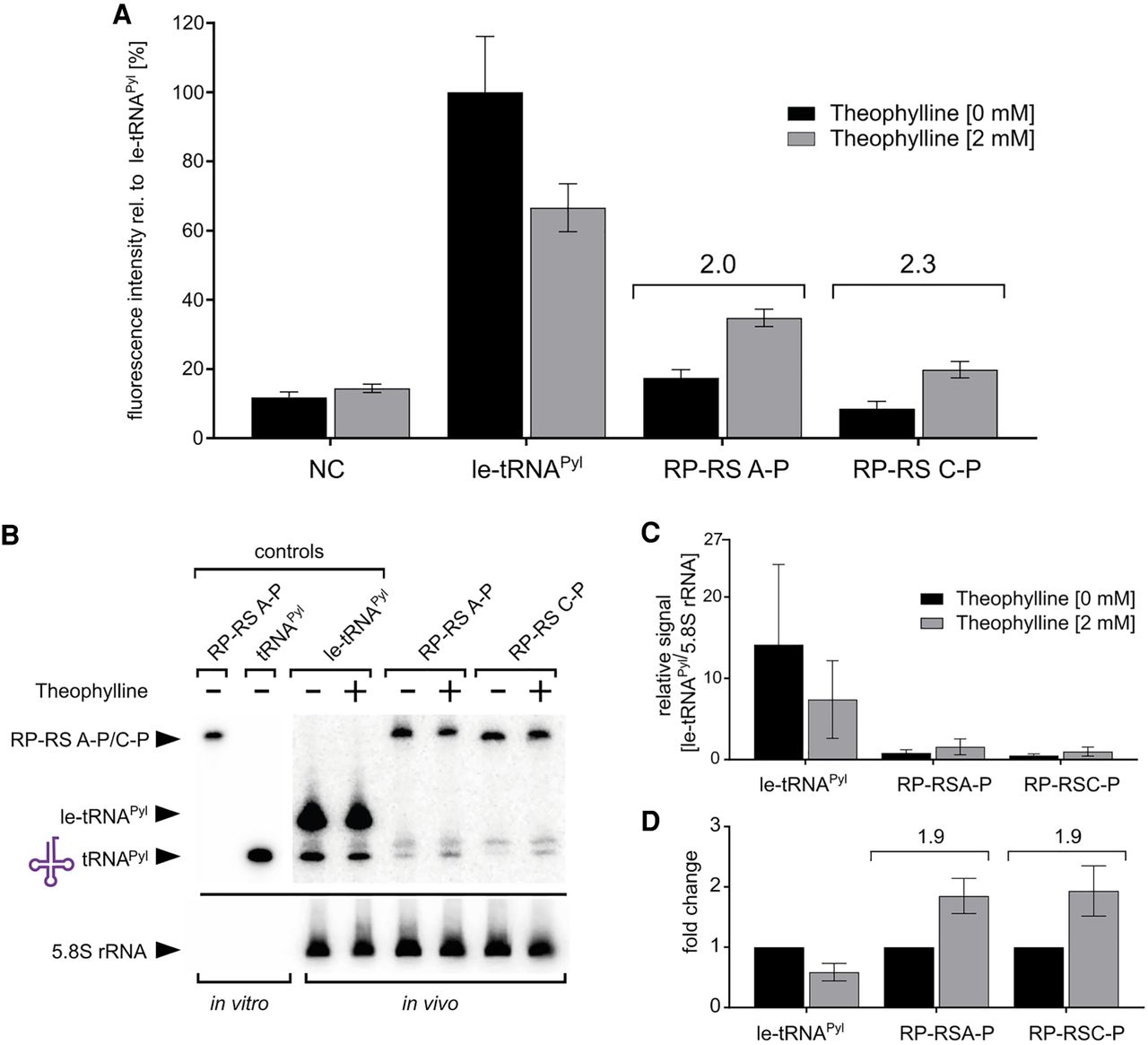
Riboswitch-controlled maturation of tRNAPyl in HEK293T cells. (A) tRNAPyl-induced stop codon suppression at position 183 in the plasmid-encoded eGFP reporter mRNA led to a fluorescent signal that was used to monitor the switching behavior of the constructs. eGFP fluorescence intensities were normalized to the mCherry fluorescence signal derived from the mcherry ORF that was also encoded on the reporter plasmid and are presented relative to le-tRNAPyl. The fluorescence signal of the control le-tRNAPyl shows a considerable reduction in the presence of the ligand, indicating a detrimental effect of theophylline on cell growth (Namba et al. 1980; Yasui and Komiyama 2001; Peng et al. 2018). Upon addition of the ligand, RP-RS A-P and RP-RS C-P show a twofold activation. Due to the negative growth effect of theophylline, this ratio is likely to be underrepresented. (NC) Negative control, tRNAPyl without upstream-encoded U6 promoter. (B) Northern blot analysis and (C) quantitation of mature tRNAPyl relative to the 5.8S rRNA signal. In agreement with the fluorescence data, the presence of theophylline leads to a reduction of mature tRNAPyl in the case of le-tRNAPyl. However, theophylline-induced fold changes (D) show a twofold activation of both riboswitch constructs. Data are mean ± SD, n = 3.




