


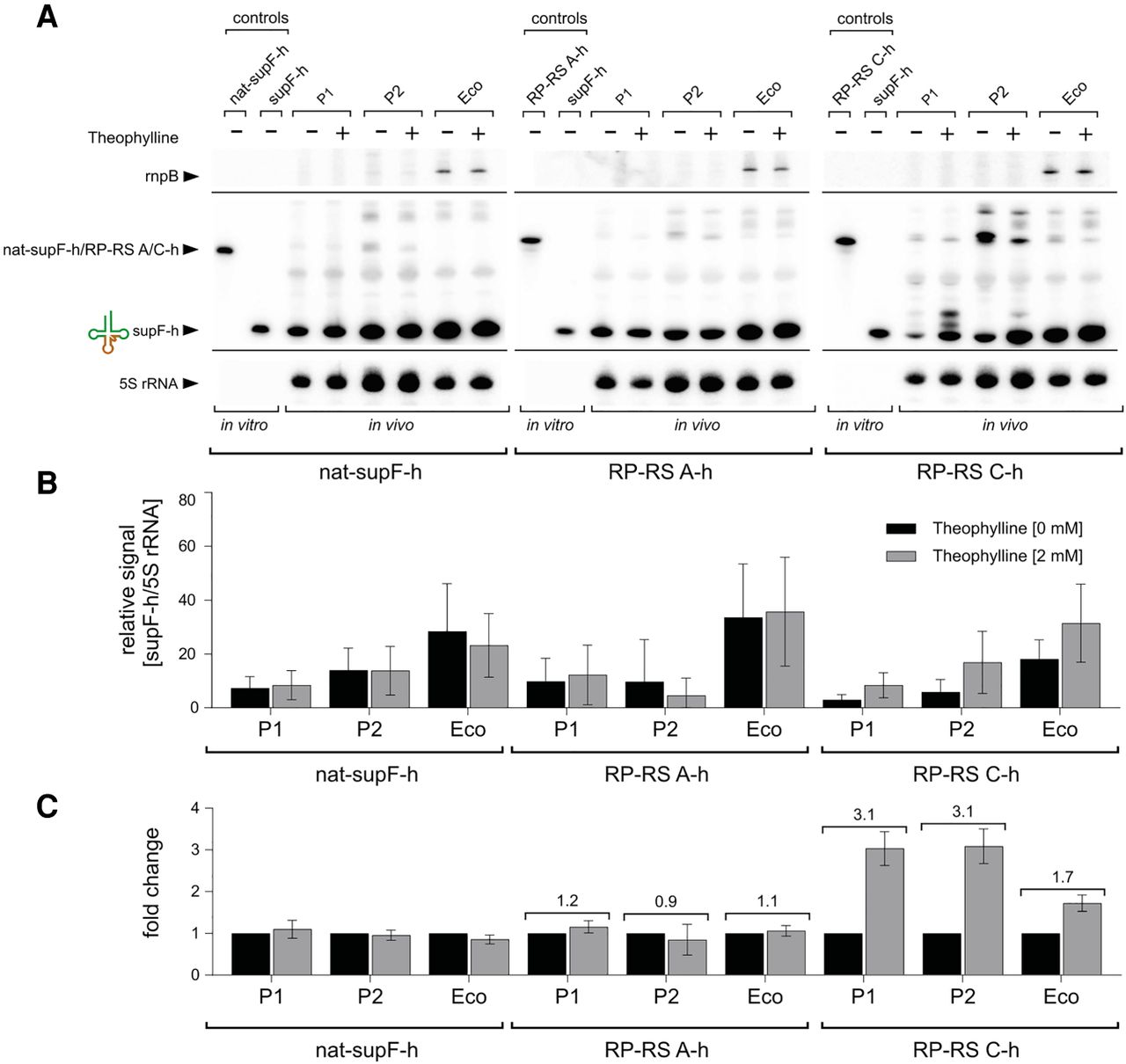
Riboswitch-controlled tRNA processing by PRORP enzymes in E. coli BW cells. (A) For the detection of processed tRNA, supF tRNA was replaced by a hybrid construct supF-h according to Ender et al. (2021). Northern blot analyses of plasmid-encoded constructs nat-supF-h, RP-RS A-h, and RP-RS C-h in E. coli BW cells with plasmids encoding genes for PRORP1 (P1), PRORP2 (P2), or the E. coli RNase P rnpB gene (Eco) are shown. A clear theophylline-dependent response was only visible for RP-RS C-h in combination with PRORP1 or PRORP2. In the case of RP-RS C-h in combination with PRORP1, further bands are visible, likely representing miscleaved precursor-tRNA fragments. (B) Relative quantitation of the mature tRNA. The corresponding hybridization signals were normalized to the signal of endogenous 5S rRNA. Only RP-RS C-h exhibits a theophylline-dependent response. The rather large error bars are the result of the variation of the absolute signal values between individual clones. Yet, all construct clones show an identical and reliable tendency of the influence of theophylline on mature tRNA supF-h release for each experiment (Supplemental Table S2). Data are mean ± SD, n = 3. (C) Theophylline-dependent fold changes of nat-supF-h, RP-RS A-h, and RP-RS C-h. For both PRORP1 as well as PRORP2, a clear theophylline-induced 3.1-fold response of RP-RS C-h was determined. The positive control Eco (E. coli RNase P) shows a 1.7-fold activation, corroborating the data of Ender et al. (2021). Data are mean ± SD, n = 3.




