


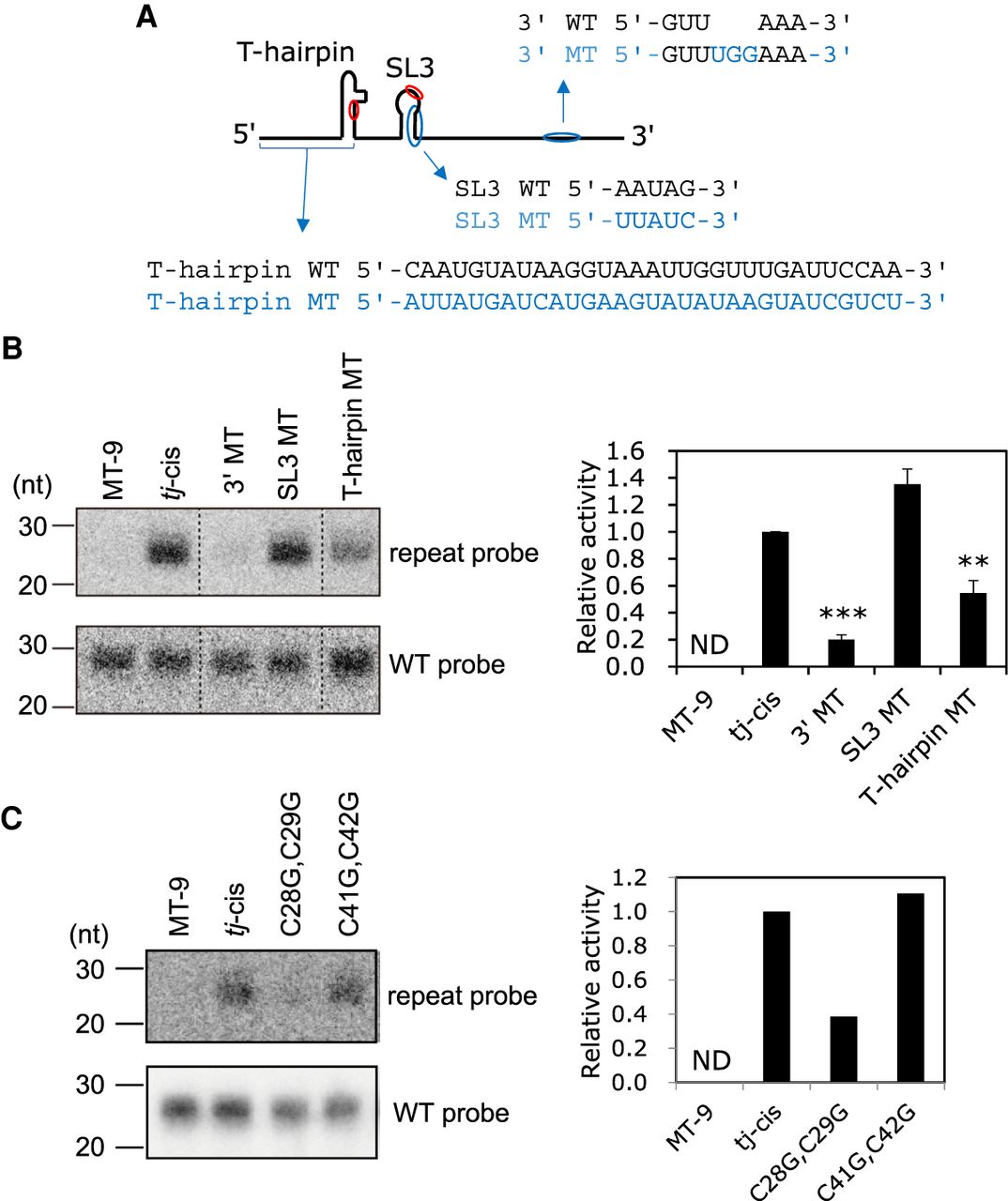
piRNA biogenesis assay. (A) Location of modifications and mutations in the Tj-cis element. The blue letters indicate the replaced or inserted sequences. Red circles indicate the location of point mutations. For T-hairpin MT, the sequence corresponding to residues 1–31 were randomized. (B) Replacement and insertion analysis of the three structural elements. (Left) MT-9 and tj-cis indicate without and with the plasmid carrying the Tj-cis element and the repeat sequences, respectively. The 3′ MT, SL3 MT, and T-hairpin MT indicate the mutations in the corresponding region in the Tj-cis element. Repeat probe shows the expression of repeat sequences inserted downstream from the Tj-cis element. WT probe shows expression of intrinsic piRNA production. (Right) Relative activity was calculated by normalizing the repeat probe signal to the WT probe signal. Bars and error bars represent means ± SEM values of four independent experiments. P-values were calculated by bootstrap resampling. (**) P < 0.01, (***) P < 0.001, (ND) not detected. (C) Point mutations in the three structural elements. (Left) MT-9 and tj-cis indicate without and with the plasmid carrying the Tj-cis element and the repeat sequences, respectively. (Right) Relative activities obtained from the image shown in the left panel.




