


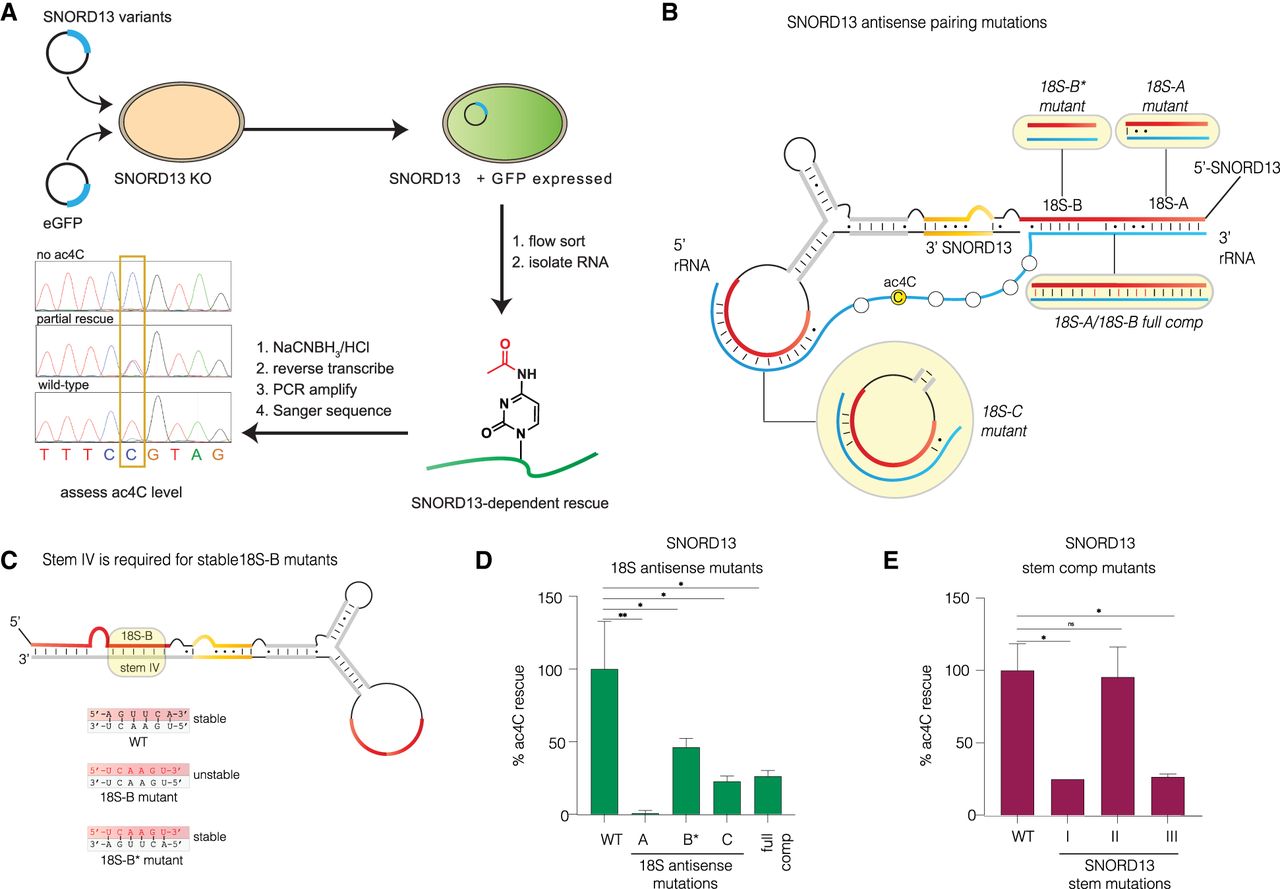
(A) Schematic for analysis of SNORD13 function using quantitative ac4C sequencing. (B) Sequence of human SNORD13s analyzed. In addition to wild-type (“WT”) sequence, disruptive mutations (18S-A, 18S-B*, 18S-C mutants), and a mutant with increased complementarity (“18S-A/18S-B full comp”) were explored for rescue of ac4C in SNORD13 KO cells. Sequences and verification of expression are provided in Supplemental Figure S4. Note the finding that the 18S-A mutant is expressed when its stem V is disrupted, implies stem V is not strictly required for SNORD13 synthesis. (C) Stem IV is required for accumulation of mutant SNORD13s. Mutation of SNORD13 in mutant 18S-B disrupts stem IV. Reintroduction of complementarity in construct 18-B* (bottom) allows accumulation and testing of function. Expression of 18S-B* is verified by RNase A/T1 mapping in Supplemental Figure S4c. (D) Rescue of SSU-ac4C1842 by SNORD13 antisense mutants. Mutants rescue values are normalized relative to the WT SNORD13, which was set to equal 100%. Background misincorporation rates in SNORD13 KO cells were 0%–4%. Values represent n = three biological replicates, analyzed by two-tailed Welch's t-test (ns = not significant, [*] P < 0.05, [**] P < 0.01, and [***] P < 0.001). Exemplary sequencing traces are provided in Supplemental Figure S4d. (E) Rescue of SSU-ac4C1842 by SNORD13 stem comp mutants. Structures of comp mutants are provided in Figure 3B. Values represent n = three biological replicates, analyzed by two-tailed Welch's t-test (ns = not significant, [*] P < 0.05, [**] P < 0.01, and [***] P < 0.001).




