


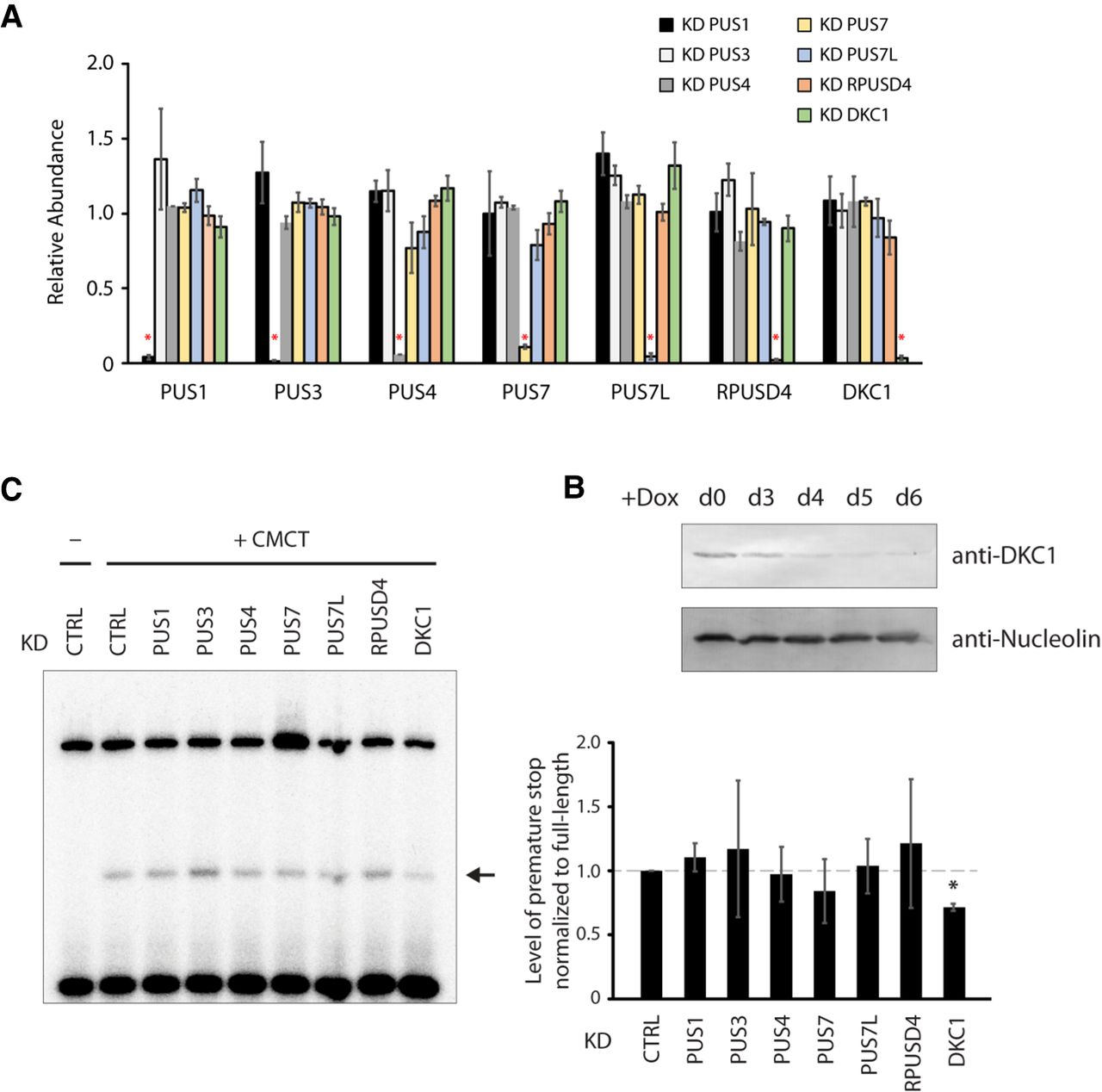
The pseudouridine synthase Dyskerin is the writer of EBER2 Ψ160. (A) All nuclear PUS enzymes were depleted in BJAB-B1 cells using CRISPR interference; their specific depletion was verified by qRT-PCR (asterisks). These cell lines were transduced with a lentiviral vector that expresses the dCas9–KRAB fusion protein and a PUS-specific sgRNA. The results are the average from three independently established knockdown cell lines for each PUS enzyme, and error bars are standard deviation. (B) As a stable knockdown cell line for the essential DKC1 protein could not be established, Tet-inducible knockdown cell lines were generated. Western blot analysis showed that efficient DKC1 depletion was observed after 4 d of Dox-addition to the culture medium. Anti-Nucleolin antibody served as a loading control. All experiments were conducted after 5 d of Dox-addition to allow for sufficient depletion of DKC1. (C) Primer extension assays of EBER2 purified from various PUS-depleted cells after CMCT treatment. A decrease in pseudouridylation at U160 of EBER2 is observed upon DKC1 depletion (arrow). Quantification of three independent experiments is shown in the graph (asterisk indicates P < 0.001 in a Student's t-test).




