


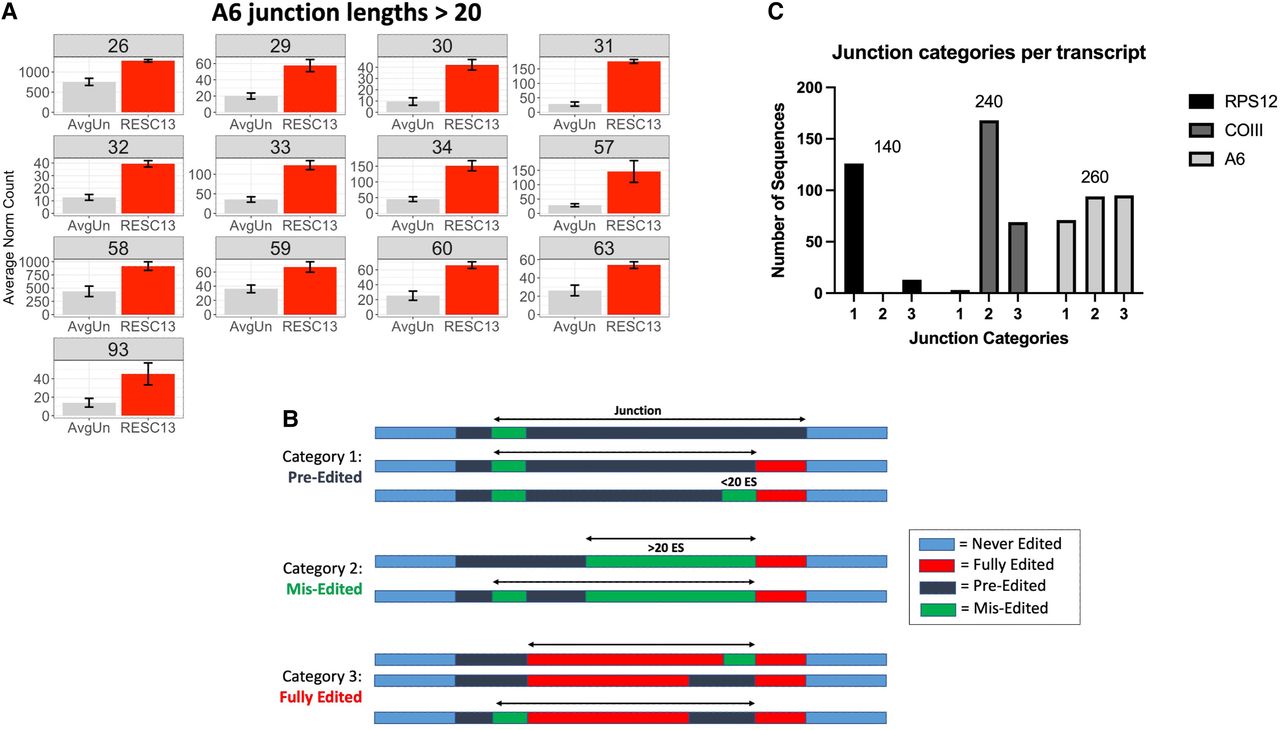
RESC13 hinders the formation of distinct classes of long junctions on different transcripts. (A) Numbers of reads at each A6 mRNA editing stop site at which junctions with lengths greater than 20 ES increase upon RESC13 RNAi compared to uninduced cells. Reads were normalized to 100,000. (B) Schematic of the different junction categories observed in RPS12, COIII, and A6 mRNA sequences that arise 5′ of the editing stop sites having junction lengths >20 upon RESC13 RNAi. Three categories were identified: (1) mainly pre-edited, (2) mainly misedited, and (3) mainly fully edited. See key for clarification of the different colored bars. (C) The top 20 junction sequences that arise 5′ of editing stop sites where junctions greater than 20 ES long increase with RESC13 RNAi for A6, COIII, and RPS12 mRNAs sorted into the three different categories. The numbers above the bars represent the total number of sequences analyzed for that transcript. Since there was a large number of junction lengths >20 editing stop sites in COIII mRNA (Supplemental Fig. S2A), only editing stop sites at which the normalized number of sequences in the induced cells was above 200 were analyzed.




