


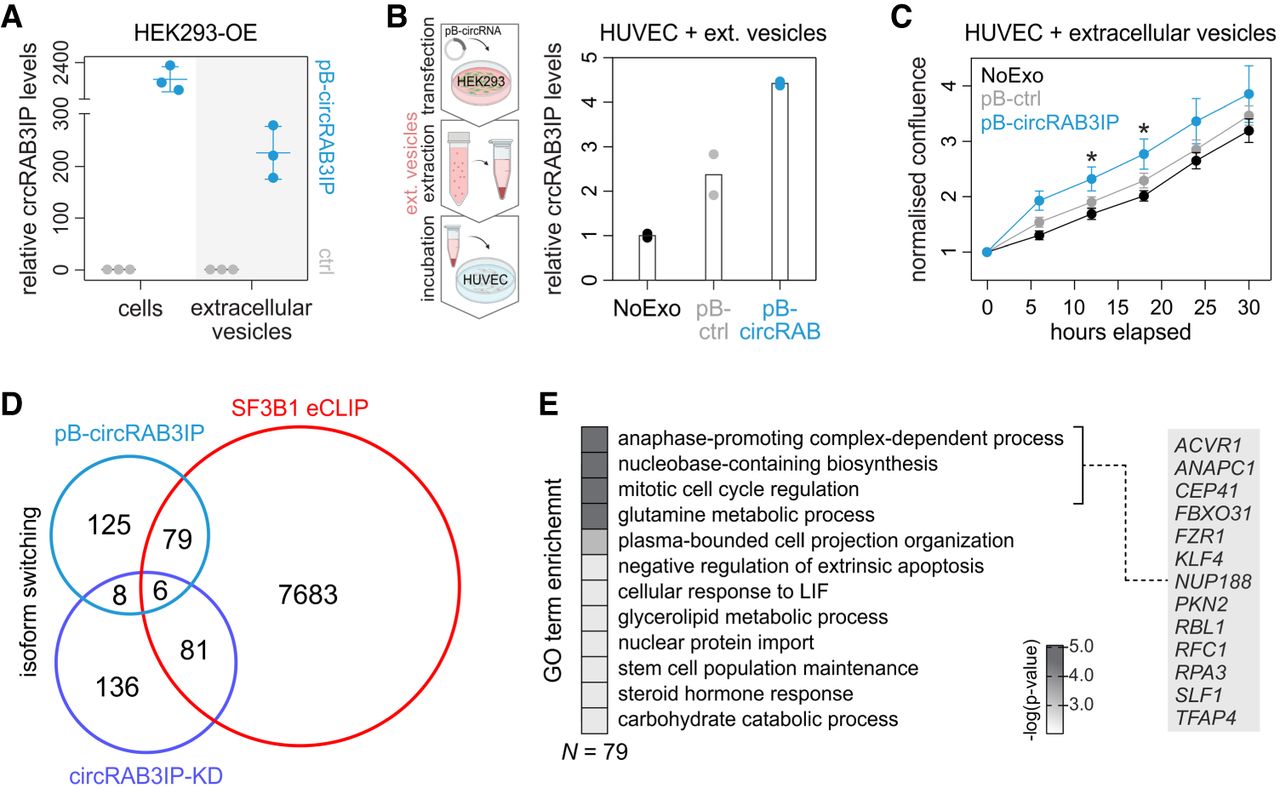
circRAB3IP acts in a cell nonautonomous manner to promote HUVEC proliferation. (A) Relative circRAB3IP levels (±SD, from three replicates) in lysates and extracellular vesicles purified from empty vector (ctrl) or pB-circRAB3IP cells (blue). (B, left) circRNA-pB HEK293 lines were induced for 48 h, before extracellular vesicles were purified and added onto growing HUVECs. (Right) As in panel A, but for HUVECs treated with extracellular vesicles from control (pB-ctrl) and pB-circRAB3IP cells, and expressed as fold-change over nontreated cell levels (NoExo). (C) Plot showing normalized area confluence (±SD) derived from live-cell imaging of HUVECs stimulated with nontreated, control, and pB-circRAB3IP exosomes from three replicates. (*) Padj < 0.05, multiple t-testing. (D) Overlap between SF3B1 eCLIP targets (red) and genes switching isoforms in circRAB3IP-KD (blue) or in pB-circRAB3IP exosome-treated cells (light blue). (E) GO terms associated with isoform-switching genes in pB-circRAB3IP exosome-treated HUVECs that are also bound by SF3B1; cell cycle–related genes are listed (gray box).




