


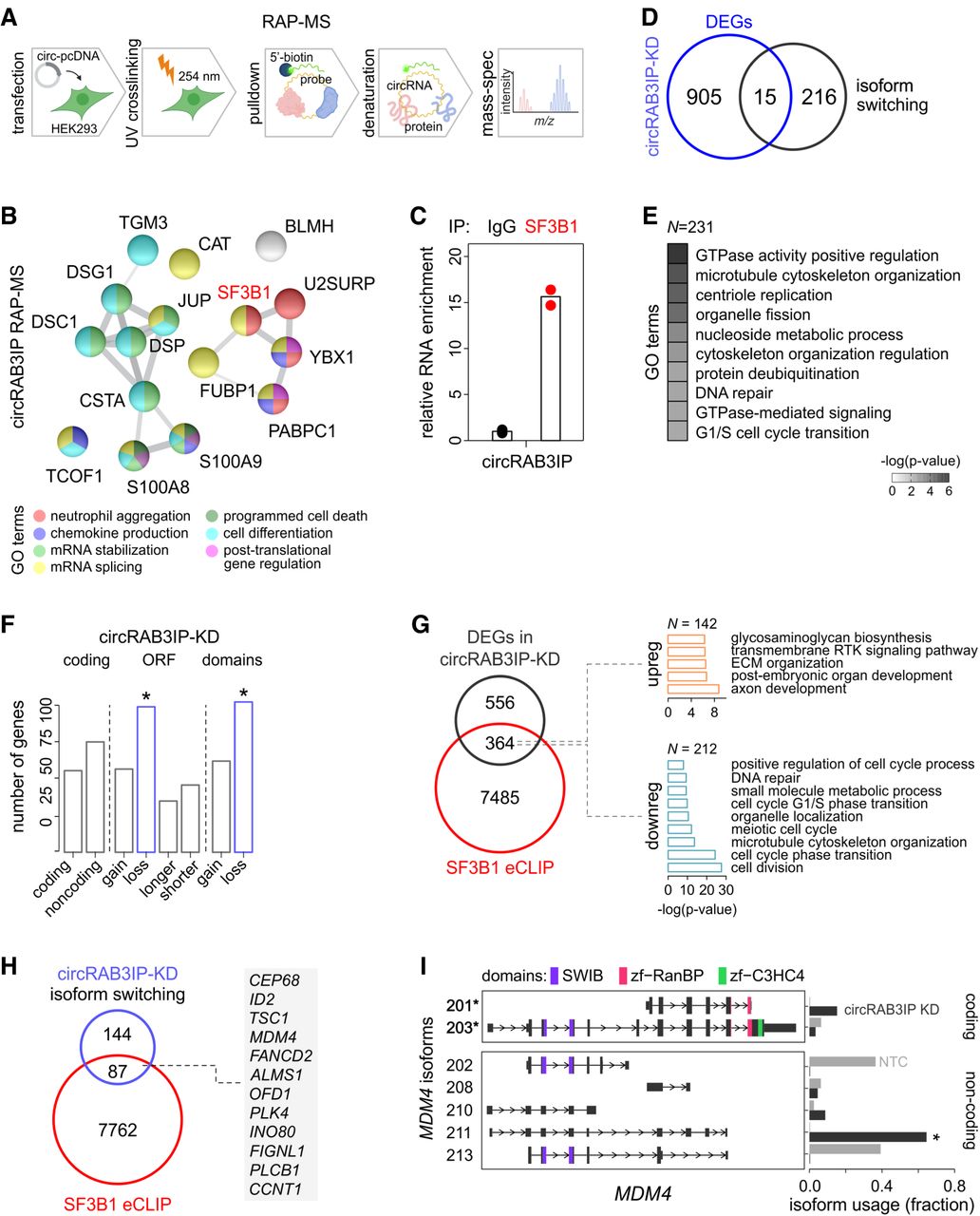
circRAB3IP interacts with SF3B1 and affects RNA splicing. (A) For RAP-MS, cells were transfected with circRNA-pcDNA3 vectors, UV crosslinked, lysed, and hybridized with biotinylated probes targeting backsplicing junctions. Following pulldown, circRNA-associated proteins were denatured and analyzed by label-free mass spectrometry. (B) Plot showing circRAB3IP-bound proteins and their interactions inferred using STRING (https://string-db.org/; from three replicates). Color coding reflects GO terms (key below) associated with each protein. (C) Plot showing circRAB3IP enrichment following SF3B1-pulldown in HUVECs normalized to input (±SD, from two replicates). IgG pulldown provides a control. (D) Overlap between DEGs and genes displaying isoform usage changes in circRAB3IP-KD data. Overlap was not more than expected by chance; P = 0.6711, hypergeometric test. (E) GO terms enriched for genes (N) with ≥30% isoform usage switching in circRAB3IP-KD data. (F) Bar plot of isoform usage types in circRAB3IP-KD data. (*) FDR < 0.05. (G) Venn diagram (left) showing the overlap between SF3B1-bound mRNAs and DEGs in circRAB3IP-KD. GO terms (right) linked to overlapping up-/down-regulated genes (orange/blue). (H) Venn diagram showing overlap between SF3B1-bound and differentially spliced mRNAs upon circRAB3IP-KD. (*) More than expected by chance; P < 0.001, hypergeometric test. Genes involved in cell cycle regulation are listed (gray box; https://gsea-msigdb.org). (I) MDM4 isoforms (left) detected upon circRAB3IP-KD. Functional domains in each isoform (color code, top) and coding isoforms (*) are indicated. Bar plot (right) showing usage changes between KD (black) and control RNA-seq data (gray) for each isoform. (*) FDR ≤ 0.001.




