


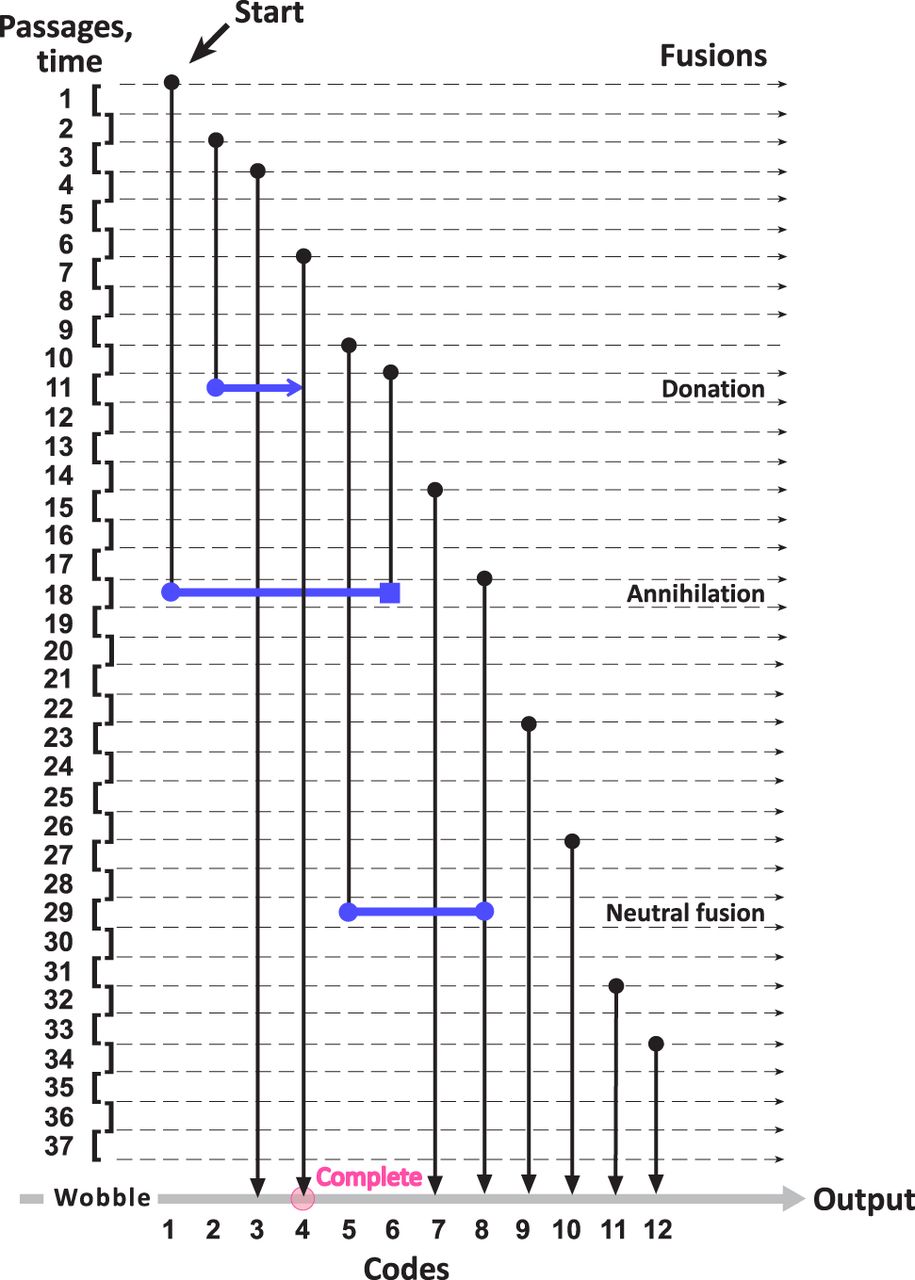
Code evolution in one simplified environment. For explanatory purposes, Figure 7 shows only 37 passages (environments can have thousands) and 12 codes (environments can have hundreds). Passages are time for one event in coding evolution: individual passages vary stochastically, but are shown similarly for clarity. However, the mean passage is defined, marking time reasonably precisely. Each environment begins with a single table, labeled “Start.” New tables appear in Figure 7 with constant probability per passage (Ptab), starting with a single arbitrary assignment (Pinit). At each passage, all current tables evolve by one step: a new assignment (Pinit), random (Prand) or SGC-like (1—Prand), an assignment decay (Pdecay), or capture of an unassigned codon one mutation distant (Pmut). As soon as multiple tables arise, they can fuse with {probability Pfus/passage} × {number of codes − 1}. Three kinds of fusions exist, each decreasing total codes. The vanishing code can contribute assignments to a recipient (“Donation”). The vanishing code can be lost, along with its incompatible recipient (“Annihilation”). The vanishing code can cause no change if all its assignments already exist in the recipient (“Neutral fusion”). An environment is completed (“Complete”) at a set time, or when a code with desired properties arises (translucent red circle), such as encoding ≥20 assigned functions. Wobble (late Crick wobble, lCw) evolves later (Yarus 2021b), after fundamental assignments are made. The program usually reports (“Output”) averages of all codes, or alternatively, properties of best codes (e.g., most complete: translucent red circle). In Figure 7, this best code (Code 4) has evolved in part by receiving assignments from fusion.




