


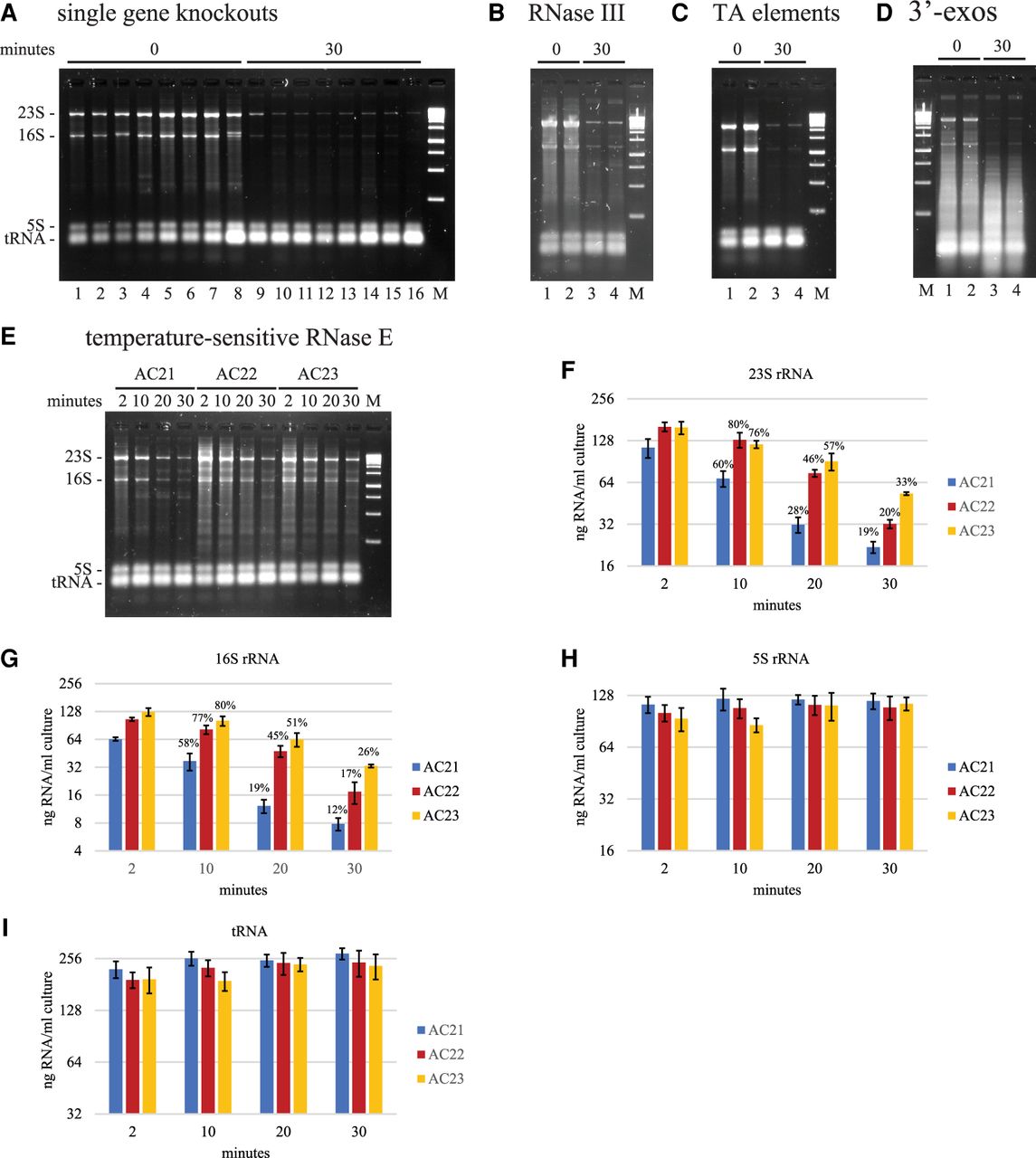
Ribonucleases involved in rifampicin-induced rRNA degradation. Total RNA extracted from equal volumes of culture was separated by agarose gel electrophoresis. The gels were imaged by SYBR Safe staining. M = DNA size markers. In panels A–D, the 0 min time points were taken immediately after the addition of rifampicin (150 µg/mL). (A) Single gene knockouts. Lanes 1 to 8 correspond to mutant strains with gene deletions that result in the loss of the following proteins: RNase I, RNase II, RNase G, RNase R, RNase PH, poly(A)polymerase, PNPase and YbeY. (B) RNase III. Rifampicin treatment of the BL321 strain, which contains the rnc105 mutant allele resulting in a lack of RNase III activity (Portier et al. 1987). (C) TA elements. Rifampicin treatment of the ΔTA10 strain, in which ten toxin-antitoxin elements have been disrupted (Goormaghtigh et al. 2018). Each of these elements encodes an mRNA interferase that inactivates mRNA by endoribonucleolytic cleavage. (D) 3′-exos. Rifampicin treatment of the CA244 strain, which contains a knockout of the rnr gene encoding RNase R and the mutant pnp200 allele encoding a temperature-sensitive variant of PNPase (Cheng and Deutscher 2003). The strain was grown to OD600 = 0.1 at 30°C in LB and then shifted to 42°C. Rifampicin was added 4 h after the temperature shift. (E) RNase E. AC21, AC22, and AC23 are isogenic strains containing the rne+, rne(F68L)ts, and rne(G66S)ts alleles, respectively (Carpousis et al. 1994). The strains were grown to OD600 = 0.5 at 30°C in LB and then shifted to 43.5°C for 10 min before the addition of rifampicin (150 µg/mL). RNA was extracted 2, 10, 20, and 30 min after the addition of rifampicin. (F–I) Quantification of RNA levels. The bar graphs show the average and standard deviation of 23S, 16S, and 5S rRNA, and tRNA levels from three biological replicates performed as shown in E. AC21 is the isogenic wild-type control. AC22 and AC23 harbor mutant alleles encoding temperature-sensitive variants of RNase E. Percentages represent normalization to the 2 min time point.




