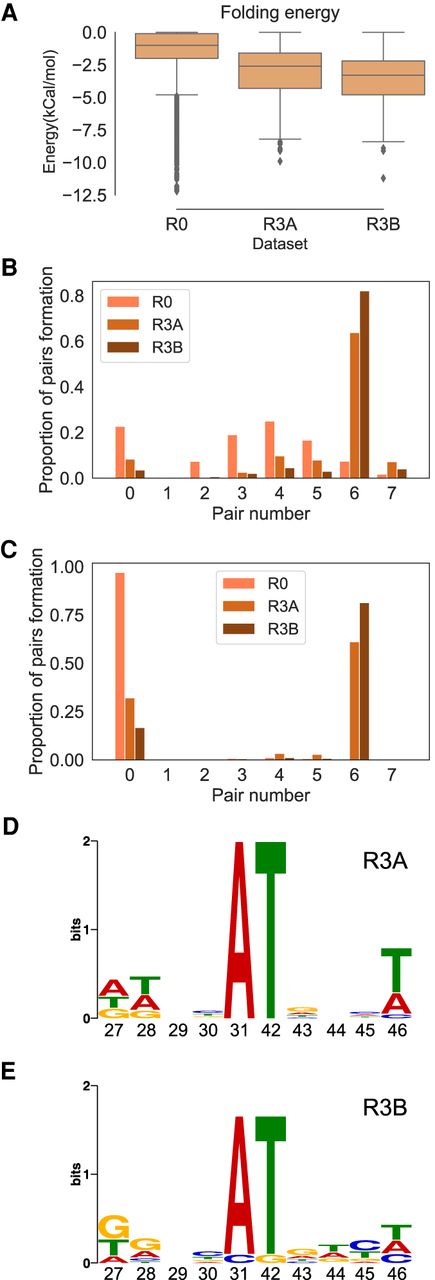
FIGURE 4.
Characterization of the sequences contained in the starting and round three enriched libraries. (A) Folding energy of the sequences computed using RNAfold program from the ViennaRNA Package. (B) Base-pair formation in the P3–L3 stem–loop. The number of base pairs formed was extracted from the optimal secondary structure in dot-bracket notation generated by the RNAfold program of the ViennaRNA Package. (C) Base-pair formation in the P3 stem only. Here, any sequence displaying at least 1 bp involving L3 was set to 0. (D,E) Motif identified in the 50 sequences displaying the highest occurrence in R3A (D) or R3B (E) library. The motifs were generated using MEME algorithm (Bailey and Elkan 1994).