


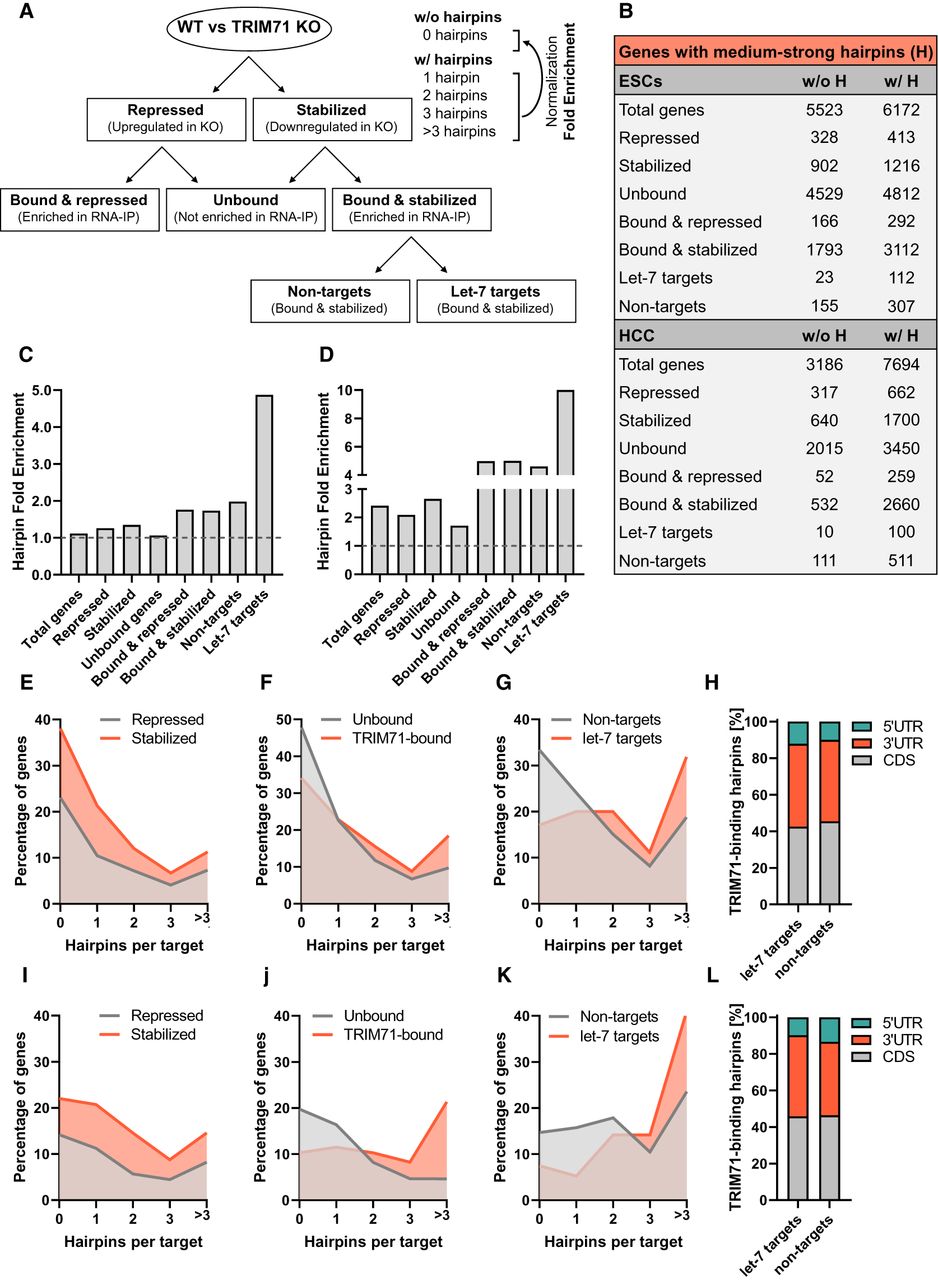
let-7 targets bound and stabilized by TRIM71 in ESCs and HCC cells are heavily enriched in TRIM71-binding hairpins. (A) Schematic representation for the target groups analyzed for the identification of RNA structural elements well-characterized as TRIM71-binding hairpins. (B) Number of genes with (w/ H) and without (w/o H) medium or strong hairpins (hairpin strength classification according to Welte et al. 2019) identified in the different target groups depicted in A. (C) Hairpin fold change enrichment in ESCs and (D) HCC cells, calculated from values specified in B by dividing the number of “targets w/ H,” in which one or more middle or strong hairpins were identified, by the number of “targets w/o H” (represented by the baseline), in which neither medium nor strong hairpins were identified. (E–G) Percentage of genes with 0, 1, 2, 3, or >3 hairpins identified in the specified target groups in ESCs. (H) Number of TRIM71-binding hairpins identified within the 5′UTR, coding sequence (CDS) and 3′UTR of mRNAs found to be bound and stabilized by TRIM71 in ESCs, depicted as percentages. (I–K) Percentage of genes with 0, 1, 2, 3, or >3 hairpins identified in the specified target groups in HCC cells. (L) Number of TRIM71-binding hairpins identified within the 5′UTR, CDS and 3′UTR of mRNAs found to be bound and stabilized by TRIM71 in HCC cells.




