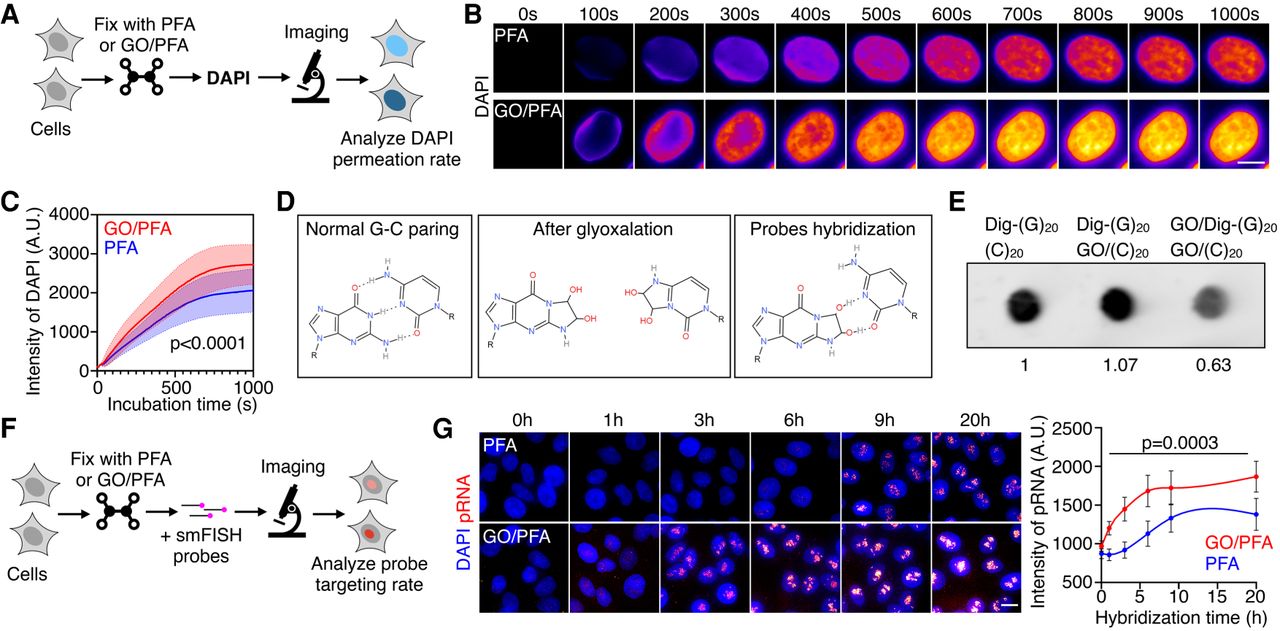
Glyoxal/PFA fixation improves RNA FISH efficiency by improving nuclear permeability and probe accessibility. (A) Schematic of the process to detect nuclear permeability. (B) GO/PFA fixation augments the nuclear permeability shown as a faster DAPI penetration under GO/PFA than PFA alone. Scale bar: 5 µm. (C) Statistics of B. Statistics were counted from more than 50 cells across three independent experiments under each condition. Mean ± SD and extra sum-of-squares F-test are shown. (D) An illustration of the effect of glyoxalation on RNA denaturation and the probe hybridization. Glyoxal reacts with nucleic acids and could introduce an additional ring onto guanosine residues to block the formation of G–C pairing (Nakaya et al. 1968; Broude and Budowsky 1971; McMaster and Carmichael 1977) while the exogenously introduced probes may still possibly bind to the glyoxalated-RNA. (E) Dot blots show that glyoxalation of RNA has minimal effect on probes hybridization. (F) Schematic of the process for detection of probe accessibility. (G) GO/PFA fixation augments the probe accessibility. Note that pRNA is a type of RNA polymerase I transcribed ncRNA that is tightly associated with rDNA promoter and related RBPs (Strohner et al. 2001; Zhou and Grummt 2005; Mayer et al. 2006). Statistics were quantified from more than 20 cells across three independent experiments under each condition. Mean ± SD and paired t-test are shown. Scale bar: 10 µm.