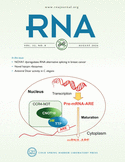
A noncanonical microRNA derived from the snaR-A noncoding RNA targets a metastasis inhibitor
- Daniel Stribling1,2,3,7,
- Yi Lei4,5,7,8,
- Casey M. Guardia4,5,7,9,
- Lu Li4,5,
- Christopher J. Fields4,5,
- Pawel Nowialis5,6,
- Rene Opavsky5,6,
- Rolf Renne1,2,3,5 and
- Mingyi Xie2,4,5
- 1Department of Molecular Genetics and Microbiology, University of Florida, Gainesville, Florida 32610, USA
- 2UF Genetics Institute, University of Florida, Gainesville, Florida 32610, USA
- 3UF Informatics Institute, University of Florida, Gainesville, Florida 32611, USA
- 4Department of Biochemistry and Molecular Biology, University of Florida, Gainesville, Florida 32610, USA
- 5UF Health Cancer Center, University of Florida, Gainesville, Florida 32610, USA
- 6Department of Anatomy and Cell Biology, University of Florida, Gainesville, Florida 32610, USA
- Corresponding authors: mingyi.xie{at}ufl.edu, rrenne{at}ufl.edu
-
↵7 These authors contributed equally to this work.
Abstract
MicroRNAs (miRNAs) are small noncoding RNAs that function as critical posttranscriptional regulators in various biological processes. While most miRNAs are generated from processing of long primary transcripts via sequential Drosha and Dicer cleavage, some miRNAs that bypass Drosha cleavage can be transcribed as part of another small noncoding RNA. Here, we develop the target-oriented miRNA discovery (TOMiD) bioinformatic analysis method to identify Drosha-independent miRNAs from Argonaute crosslinking and sequencing of hybrids (Ago-CLASH) data sets. Using this technique, we discovered a novel miRNA derived from a primate specific noncoding RNA, the small NF90 associated RNA A (snaR-A). The miRNA derived from snaR-A (miR-snaR) arises independently of Drosha processing but requires Exportin-5 and Dicer for biogenesis. We identify that miR-snaR is concurrently up-regulated with the full snaR-A transcript in cancer cells. Functionally, miR-snaR associates with Ago proteins and targets NME1, a key metastasis inhibitor, contributing to snaR-A's role in promoting cancer cell migration. Our findings suggest a functional link between a novel miRNA and its precursor noncoding RNA.
Keywords
Footnotes
-
Article is online at http://www.rnajournal.org/cgi/doi/10.1261/rna.078694.121.
- Received January 26, 2021.
- Accepted March 24, 2021.
This article is distributed exclusively by the RNA Society for the first 12 months after the full-issue publication date (see http://rnajournal.cshlp.org/site/misc/terms.xhtml). After 12 months, it is available under a Creative Commons License (Attribution-NonCommercial 4.0 International), as described at http://creativecommons.org/licenses/by-nc/4.0/.