


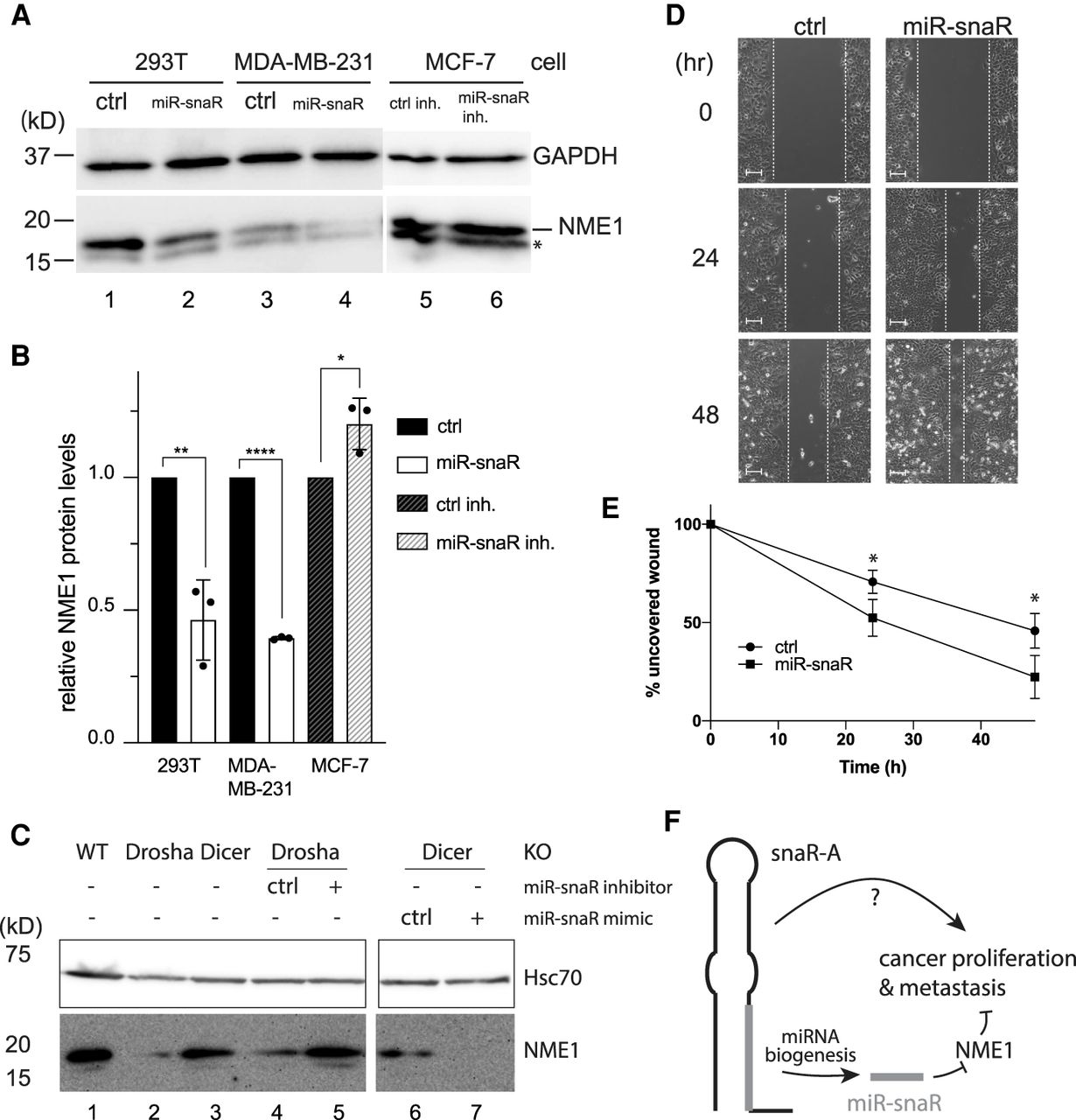
miR-snaR down-regulates NME1 to promote cell migration. (A) Western blots show reduction of NME1 protein in 293T and MDA-MB-231 cells after transfection of miR-snaR mimic and increase of NME1 protein in MCF-7 cells after transfection of miR-snaR inhibitor, with GAPDH as a loading control. Asterisk (*) marks a nonspecific band that is unlikely to be the reported smaller isoform of NME1, whose 3′-UTR also contains the miR-snaR target site. (B) Quantitation of three experiments in A is represented in a bar-graph. All differences are statistically significant (Student's t-test, [**] P ≤ 0.05; [**] P ≤ 0.01; [****] P ≤ 0.0001). (C) Western blot of NME1 protein in HCT116 WT, Drosha-KO, and Dicer-KO cells. Drosha-KO and Dicer-KO cells were additionally transfected with miR-snaR inhibitor/control and miR-snaR mimic/control, respectively. Hsc70 is used as a loading control. (D) Wound healing assay of MCF-7 cells transfected with miR-snaR mimic or a control mimic. White lines outline the edge of the scratched wound. Scale bar: 100 µm. (E) Quantification of three experiments as shown in D. (Student's t-test, [*] P ≤ 0.05). (F) Model of snaR-A's role in enhancing tumor growth and metastasis. Derived from snaR-A, miR-snaR is inhibiting NME1 to promote metastasis.




