


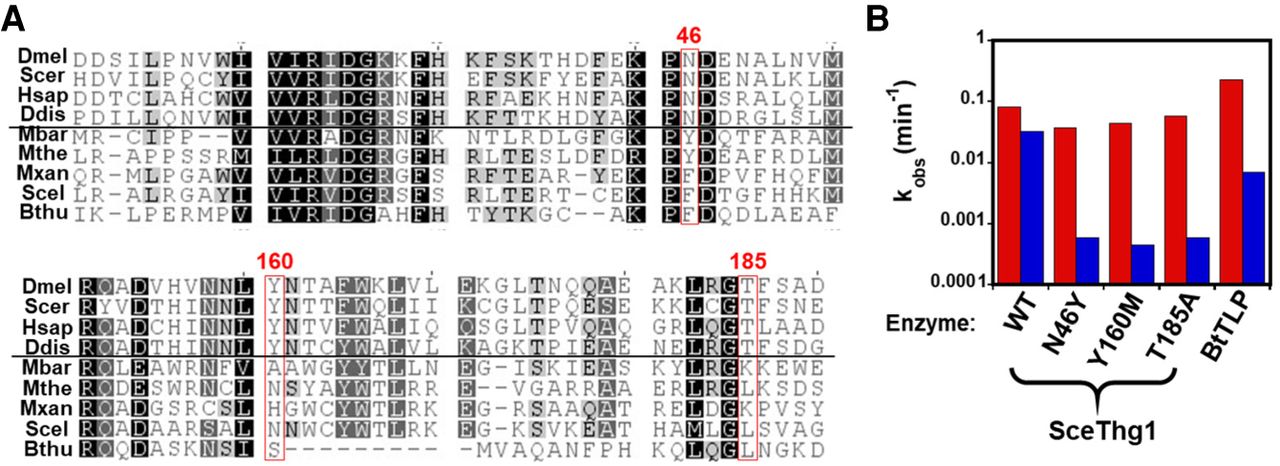
Identification of SceThg1 residues that affect non-WC base-paired nucleotide addition. (A) Selected segments from a multiple sequence alignment of Thg1 enzymes from D. melanogaster (Dmel), S. cerevisiae (Scer), H. sapiens (Hsap), and D. discoideum (Ddis) compared with TLP enzymes from M. barkeri (Mbar), M. thermoautotrophicus (Mthe), M. xanthus (Mxan), S. cellulosum (Scel), and B. thuringiensis (Bthu). The top panel shows a region corresponding to residues 15–54 of SceThg1; the bottom panel shows a region corresponding to residues 150–189 of SceThg1. Residues altered in SceThg1 in this work are highlighted in red. (B) G−1 addition activities of purified SceThg1 WT and variants (15 µM each) measured under single-turnover conditions with 5′32P-labeled monophosphorylated tRNAHis substrates. Red bars correspond to measured kobs for addition of WC base-paired G−1 to C73-tRNAHis, and blue bars correspond to kobs for addition of non-WC base-paired G−1 to A73-tRNAHis. Control reactions with BtTLP were performed under identical conditions to indicate the expected TLP preference for WC over non-WC base-pair formation.




