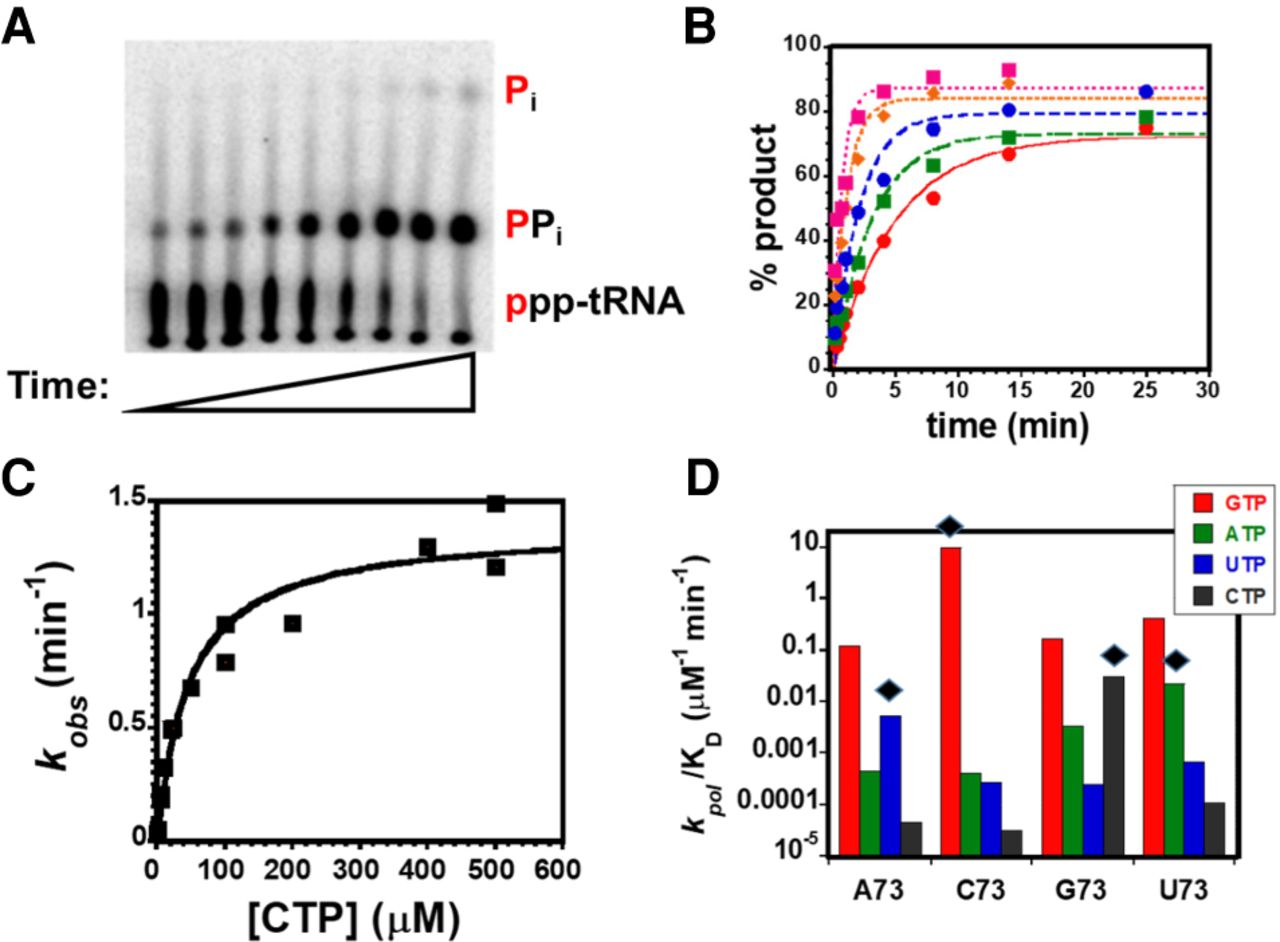
Single-turnover kinetic analysis of Thg1 3′–5′ addition activity with tRNA substrates. (A) Representative time course of Thg1 nucleotidyl transfer activity. 5′-*ppp-tRNAHis (position of the labeled phosphate indicated in red) substrates are resolved from the PPi products of nucleotidyl transfer by thin-layer chromatography, as described in Materials and Methods. At longer times, some of the PPi is further hydrolyzed to Pi, and both products are quantified to measure % product formation as a function of time. (B) Measurement of single-turnover kobs values for individual time courses was performed as described in Materials and Methods, with reaction progress curves fit to Equation 1 to yield kobs for the indicated substrate and [NTP]. In this representative example, CTP addition to ppp-G73tRNAHis was observed at 5 µM (red), 10 µM (green), 20 µM (blue), 100 µM (orange), and 500 µM (pink) CTP. (C) Determination of maximal rate (kpol) and apparent dissociation constant for NTP (KD) from the plot of kobs at each [CTP], as shown in B. Data shown are from three independent experiments plotted together and fit to Equation 2. (D) Catalytic efficiency (kpol/KD) measurements for nucleotidyl transfer reactions catalyzed by SceThg1 with all four N73 tRNAHis templates and each NTP substrate, as indicated. For comparison, the tRNA substrates are presented with the physiological tRNAHis (A73) substrate first, followed by results with the C73 substrate that enables WC base-pairing with the physiologically relevant GTP nucleotide. The order shown for the NTP substrates also starts with GTP for the same reason (and shows results for the two purine NTPs followed by the two pyrimidines). Diamond symbols indicate the bar for the NTP that makes a WC base-pair with each N73 substrate.