


Alexander Sergeevich Spirin (1931–2020)
Alexander Spirin was an exceptional scientist and mentor whose research and thinking about the ribosome was at the forefront of his field throughout his career. He began research in the laboratory of the renowned A.N. Belozersky in the Institute of Biochemistry of the Academy of Science of the USSR and the Department of Plant Biochemistry at Moscow State University in 1955 (Spirin 2009). Already as a graduate student, he discovered that only a small fraction of the total RNA in cells had a base composition similar to that of the cellular DNA (Belozersky and Spirin 1958); this fraction, was, of course, messenger RNA. As Spirin put it (Spirin 2009): “Thus, Belozersky and I found ourselves among the pioneers of messenger RNA studies.” In 1962, when he took over as head of the Institute upon Belozersky's retirement, Spirin began studying mRNA in fish embryos. This work led to the discovery of messenger ribonucleoprotein particles which he termed “informosomes” (Belitsina et al. 1964; Spirin 1969). Although this discovery was often dismissed at the time by researchers in the West, the notion that mRNAs exist in eukaryotic cells as RNP complexes eventually became widely accepted (Pederson 2021).
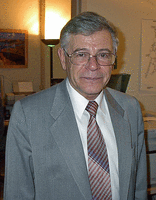
As the vast bulk of cellular RNA turned out to be a noncoding RNA (ribosomal RNA), Spirin's attention shifted to the study of ribosomes (Spirin 2009). This work was carried out mainly in the Institute for Protein Research in Pushchino, which he founded in 1967. Under Spirin's leadership, it was to become one of the preeminent research centers in the world. Among the many early discoveries from his laboratory was the finding that a subset of ribosomal proteins could be removed selectively at high salt concentrations, and that active ribosomes could be reconstituted by combining these split proteins with the RNP cores—one of the first demonstrations of in vitro reconstitution of ribosomes (Lerman et al. 1966; Spirin et al. 1966).
One of Spirin's main continuing interests was the mechanism of ribosomal translocation, a process catalyzed by the GTPase elongation factor EF-G. The exciting discovery in Pestka's laboratory of spontaneous translocation in the absence of EF-G (Pestka, 1968) was nevertheless open to the criticism that his in vitro system could be contaminated with small amounts of EF-G. Realizing that the activity of EF-G could be abolished by treatment with the sulfhydryl reagent PCMB, Gavrilova and Spirin showed that an in vitro system treated with PCMB not only retained the ability to carry out spontaneous translocation, but was actually stimulated by the treatment (Gavrilova and Spirin 1971, 1972). These experiments thus ruled out the possibility that translocation was catalyzed by trace amounts of EF-G in the translation mixture, and demonstrated that the mechanism of translocation is embodied in the ribosome itself, rather than in EF-G. The observed stimulation by PCMB was then shown to be the result of modification of ribosomal protein S12 (Gavrilova et al. 1974). Further studies showed that a similar stimulation was even conferred by certain mutations in S12 or by omission of S12. These unexplained findings are likely important clues to the mechanism of translocation that have yet to be deciphered.
In 1972, Spirin became head of the Department of Molecular Biology at Lomonosov Moscow State University, where he was revered as an inspiring teacher: “At his brilliant lectures, the audiences were packed. He infected students and staff with his enthusiasm, taught them to think, set up precise experiments, and critically interpret the results” (GT Yusupova, pers. comm.). A fundamental question concerning the mechanism of coupled translocation of mRNA and tRNA is whether both the mRNA and tRNA are actively moved, or if the mechanism acts directly on tRNA, while the mRNA moves passively, by virtue of its base-pairing to the tRNA anticodon. This question was addressed in experiments demonstrating synthesis of oligo-Lysine by ribosomes in the presence of Lys-tRNA and EF-G, but in the absence of mRNA (Belitsina et al. 1981). Subsequent experiments showed that many tRNAs are capable of being translocated in the absence of mRNA (Tnalina et al. 1982). Thus, the translocation mechanism must actively move the tRNA; there remains no evidence that it acts directly on mRNA. These studies represent another profound contribution to our understanding of translocation.
The first experimental evidence for coupling of structural rearrangements of the ribosome with translocation came from studies by Spirin, Serdyuk, and May (Spirin et al. 1987), in which neutron-scattering experiments showed reproducible differences in the radius of gyration of the ribosome between its pre- and post-translocation states. Spirin (Spirin 1968), along with Bretscher (Bretscher 1968), was among the first to predict that the mechanism of translocation is based on relative movement between the two ribosomal subunits, later shown directly by cryo-EM (Frank and Agrawal 2000), intersubunit crosslinking (Horan and Noller 2007), and FRET studies (Ermolenko et al. 2007; Ermolenko and Noller 2011). He went on to propose that the mechanics of translocation are driven mainly by thermal energy as a Brownian ratchet (Spirin 2002), years before the experimental observation of spontaneous intersubunit rotation (Cornish et al. 2008). Much of his later writing expanded on these ideas, characteristically pushing the envelope with his original, insightful thinking (Spirin 2009; Finkelstein et al. 2018).
In parallel to these mechanistic studies, Spirin's laboratory was among the first to develop continuous-flow cell-free translation systems (Spirin et al. 1988), obtain three-dimensional crystals of 70S ribosomes and 30S subunits (Yusupov et al. 1991), to demonstrate cotranslational folding of nascent proteins (Kolb et al. 1994) and to describe the higher-order folding of polysomes (Afonina Zh et al. 2013). Laboratories throughout the world, including my own, benefitted from the stream of outstanding young Russian scientists trained in Spirin's Institute, many of whom have become leaders in their fields. Spirin's science was characterized by exceptional intellectual creativity, both in formulation of novel mechanistic hypotheses and in devising ingenious experimental approaches, balanced by critical thinking that relentlessly challenged the conventional wisdom of his field. He will be missed by colleagues, students, and friends everywhere.
ACKNOWLEDGMENTS
I thank Gulnara Tnalina Yusupova and Marat Yusupov for their recollections of working in Spirin's Institute in Pushchino, Thoru Pederson for sharing his unpublished paper on Spirin's discovery of Informosomes, and Laura Lancaster for her comments on the manuscript.




