


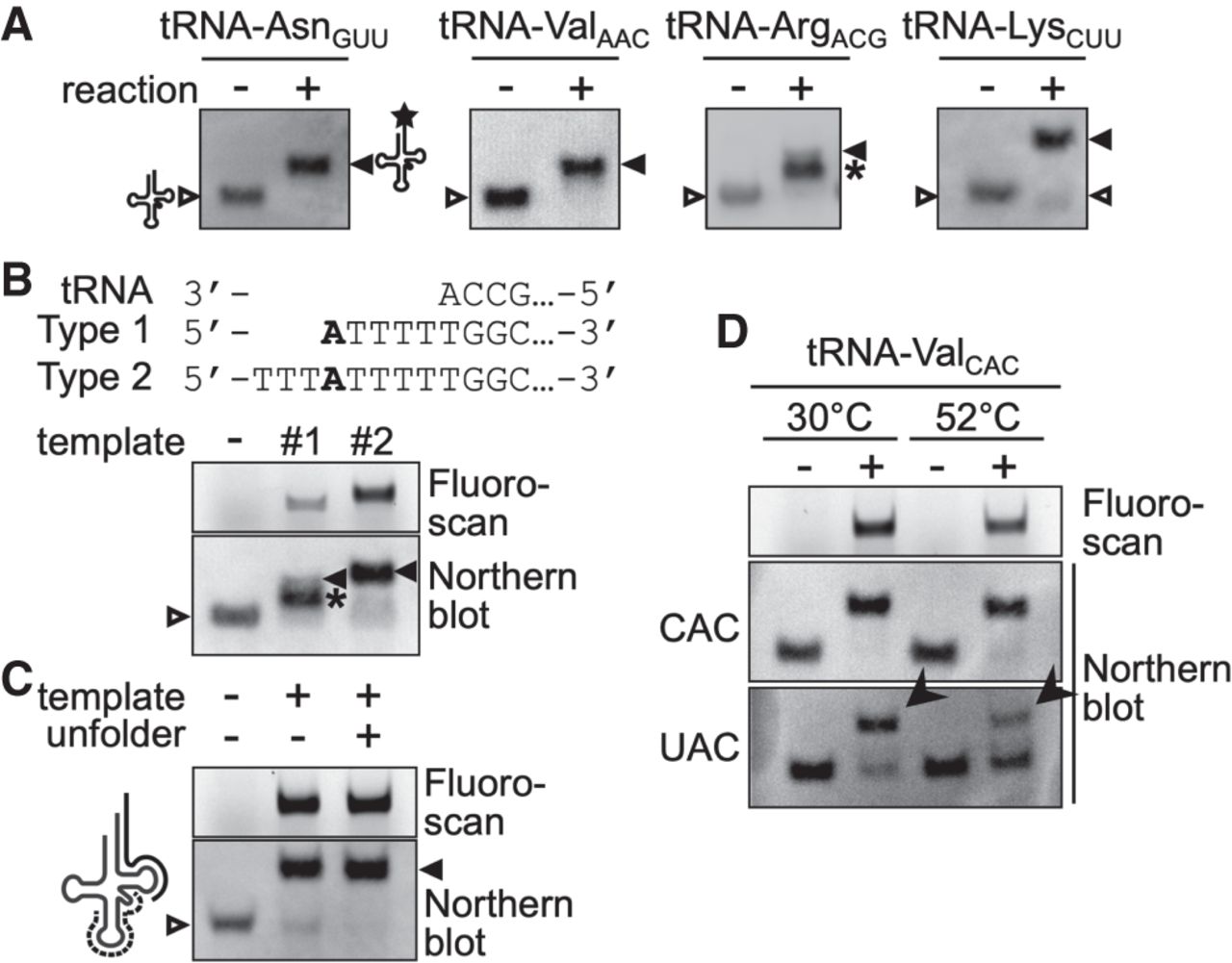
Optimization of OTTER reactions. (A) Northern blotting analyses of OTTER reactions of tRNA-AsnGUU, tRNA-ValAAC, tRNA-ArgACG, and tRNA-LysCUU to elucidate their labeling efficiencies. OTTER reactions were performed in the absence (−) or presence (+) of the corresponding Type 1 oligo DNA templates. Unextended tRNAs (open triangle), fully labeled species (closed triangle), and reaction intermediates (asterisk) are indicated. (B) A representative OTTER reaction with internal labeling. The full sequence of each oligo DNA is shown in Supplemental Table S1. OTTER reactions of tRNA-ArgACG with a Type1 template (#1), a Type 2 template (#2), or no template (−) were separated in an 8% polyacrylamide gel and were detected by fluorescence scanning (upper) and by northern blotting (lower). (C) The effect of the unfolder oligo DNA on OTTER reactions. An unfolder oligo DNA (dashed line in the schematic drawing on the left; Supplemental Table S1) was designed to be complementary to the anticodon stem–loop and variable loop regions of tRNA-LysCUU. OTTER reactions in the absence (−) or presence (+) of the unfolder were subjected to northern blotting with a probe for tRNA-LysCUU. (D) The effect of different annealing temperatures on OTTER reactions. OTTER reactions with a template oligo DNA for tRNA-ValCAC were subjected to fluorescence scanning (top) and to northern blotting with probes for tRNA-ValCAC (middle) and for tRNA-ValUAC (bottom). The bands marked by arrowheads correspond to tRNA-ValUAC cross-reacted to the tRNA-ValCAC template.




