


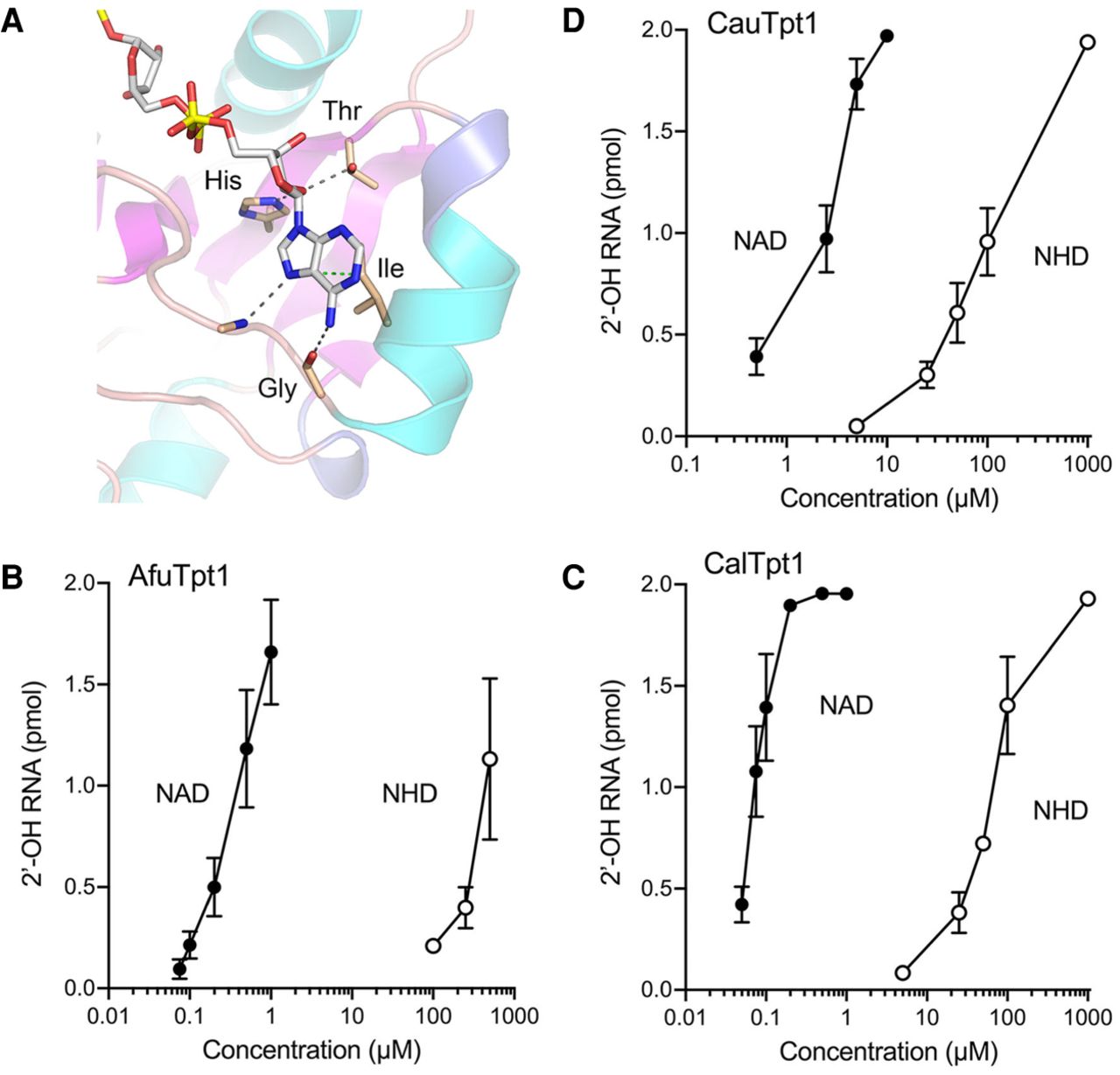
Hypoxanthine substitution for NAD+ adenine affects substrate affinity. (A) View of the interface of CthTpt1 with ADP-ribose in the crystal structure of a product-mimetic complex (from pdb 6E3A). Atomic contacts to the adenosine nucleoside are denoted by dashed lines. The indicated His, Thr, and Gly residues that mediate these contacts are conserved among Tpt1 orthologs. (B–D) Reaction mixtures (10 µL) containing 100 mM Tris-HCl, pH 7.5, 2 mM DTT, 0.2 µM (2 pmol) 5′ 32P-labeled 6-mer 2′-PO4 RNA substrate, 2 mM DTT, 2.5 fmol AfuTpt1 (B), 2.5 fmol CalTpt1 (C), or 2.5 fmol CauTpt1 (D), and NAD+ or NHD+ at the concentrations specified on the x-axes were incubated at 37°C for 30 min. The extents of formation of the 2′-OH product are plotted as a function of NAD+ or NHD+ concentration (log scale on the x-axis). Each datum is the average of three independent titration experiments ±SEM.




