


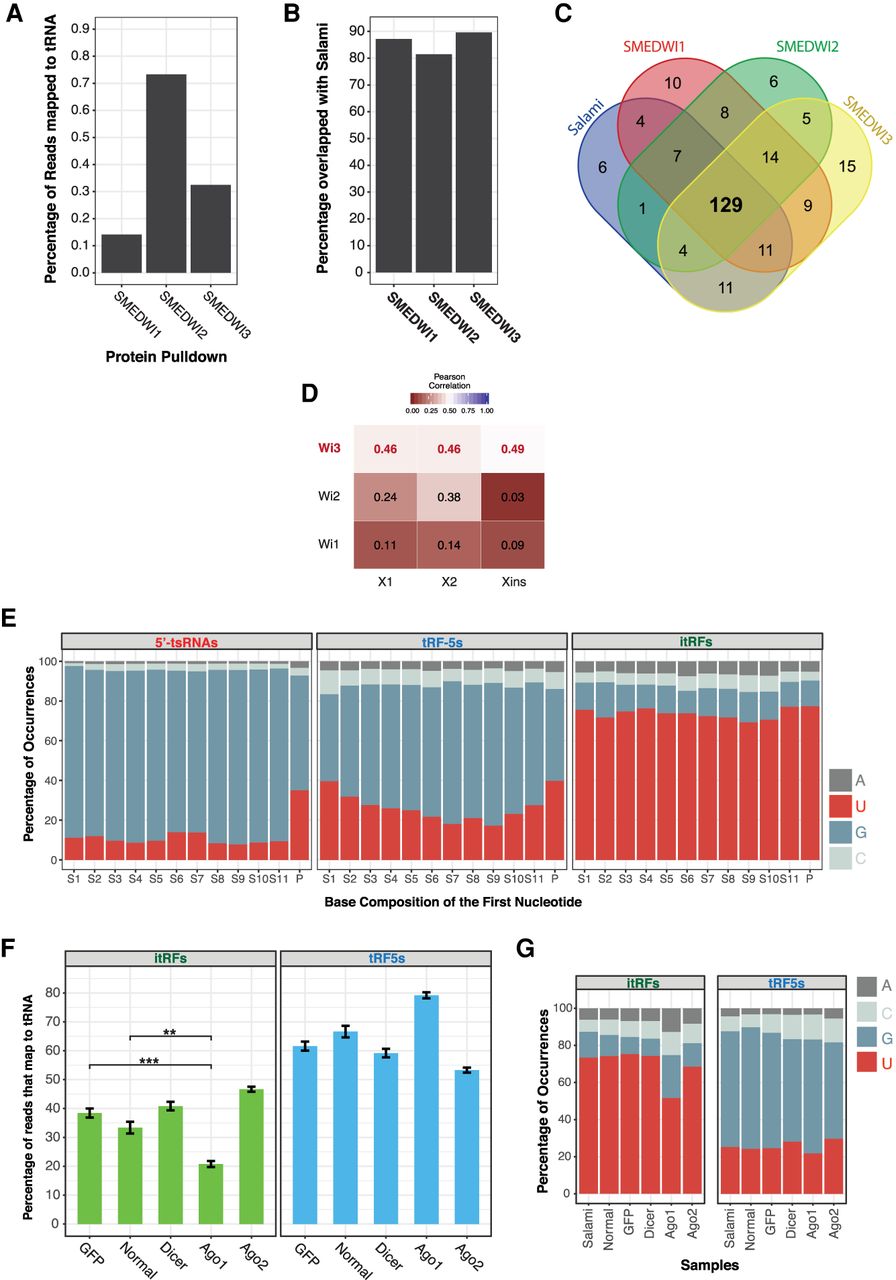
5′-tsRNA interaction with PIWI and sequence signatures in tRNA-derived fragments. (A) Percentage of SMEDWI-1, -2, and -3 interacting RNAs that map to tRNAs. (B) Percentage of identified planarian 5′tsRNAs associating with SMEDWI proteins in planaria. (C) Pie chart of the common 5′-tsRNAs identified by salami sections and the three SMEDWI-associating 5′-tsRNAs. (D) Correlation plot of 18–35 nt small RNA reads mapping to tRNA across SMEDWI-1, -2, and -3 with 18–35 small RNA reads mapping to tRNAs in X1, X2, and Xins cell populations. (E) Base preference of 5′tsRNAs, tRF-5s, and itRFs at the first position, across planaria body sections. itRFs exhibit a strong enrichment for “U.” (F) Changes in the itRF and tRF-5 population upon Dicer, Ago1, and Ago2 knockdown show decreased itRF population in Ago1 KD conditions compared to the controls (GFP dsRNA fed animals and untreated animals). Error bars represent S.E.M. (G) Base preference of itRFs at the first position across the three knockdown conditions (Dicer, Ago1, and Ago2). (**) P-value <0.01; (***) P-value <0.001.




