


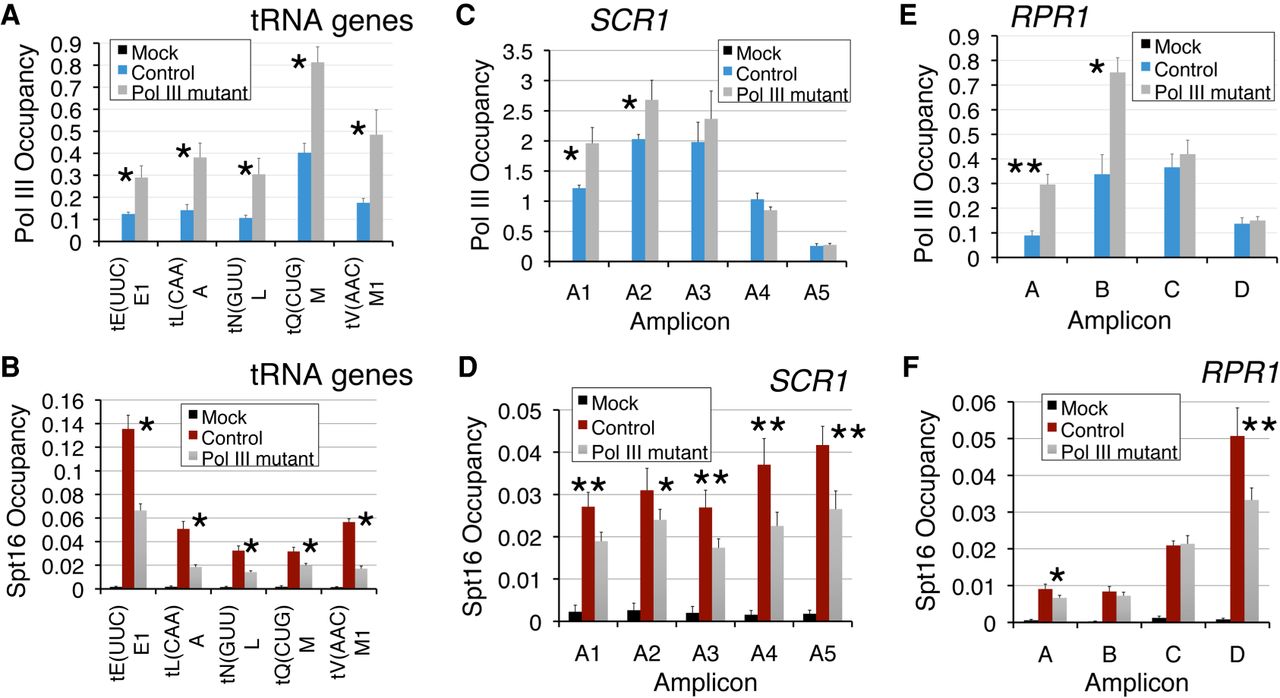
DS enrichment of Spt16 depends on the transcription process. Cells harboring 3XHA-tagged either the wild-type (control) or mutated Rpc160 (rpc160-112) were used to follow the effect of slow elongation on Spt16 occupancy (using Spt16-specific antibody) on different Pol III-transcribed genes. Relative Pol III (top panels) and Spt16 (bottom panels) occupancies were measured at the 5′ and 3′ gene ends, respectively. All enrichments (% Input method) on different Pol III-transcribed tRNA or non-tRNA genes were measured by the ChIP-real time PCR method. (A,B) Pol III and Spt16 enrichments require normal Pol III transcription on tRNA genes. (A) Pol III occupancies in the upstream and 5′ gene end. For all the genes, P < 0.00001 and (B) Spt16 occupancy in the DS region of selected tRNA genes. For all the genes, P < 0.0001. (C,E) The Pol III occupancies at different locations over the (C) SCR1 and (E) RPR1 gene body in the Pol III mutant compared to the control cells. P < 0.00001 for A1, A2 (panel C), and (**) A (panel E); <0.00007 for (*) B (panel E) amplicons. (D) Spt16 occupancy at different positions on the SCR1 gene are lower than the wild-type levels in the Pol III mutant cells. The P-values are 0.0006 for (**) A1, 0.0139 for (*) A2, 0.0005 for (**) A3 and (**) A4, 0.0001 for (**) A5. (F) On the RPR1 gene, mutant Pol III pausing at the 5′-half of the gene body (panel E, at A and B) results in (F) lower Spt16 levels at the rest of the gene in the 3′-half region (P-value = 0.0023 for [*] A, 0.1133 for B and 0.0005 at [**] D).




