


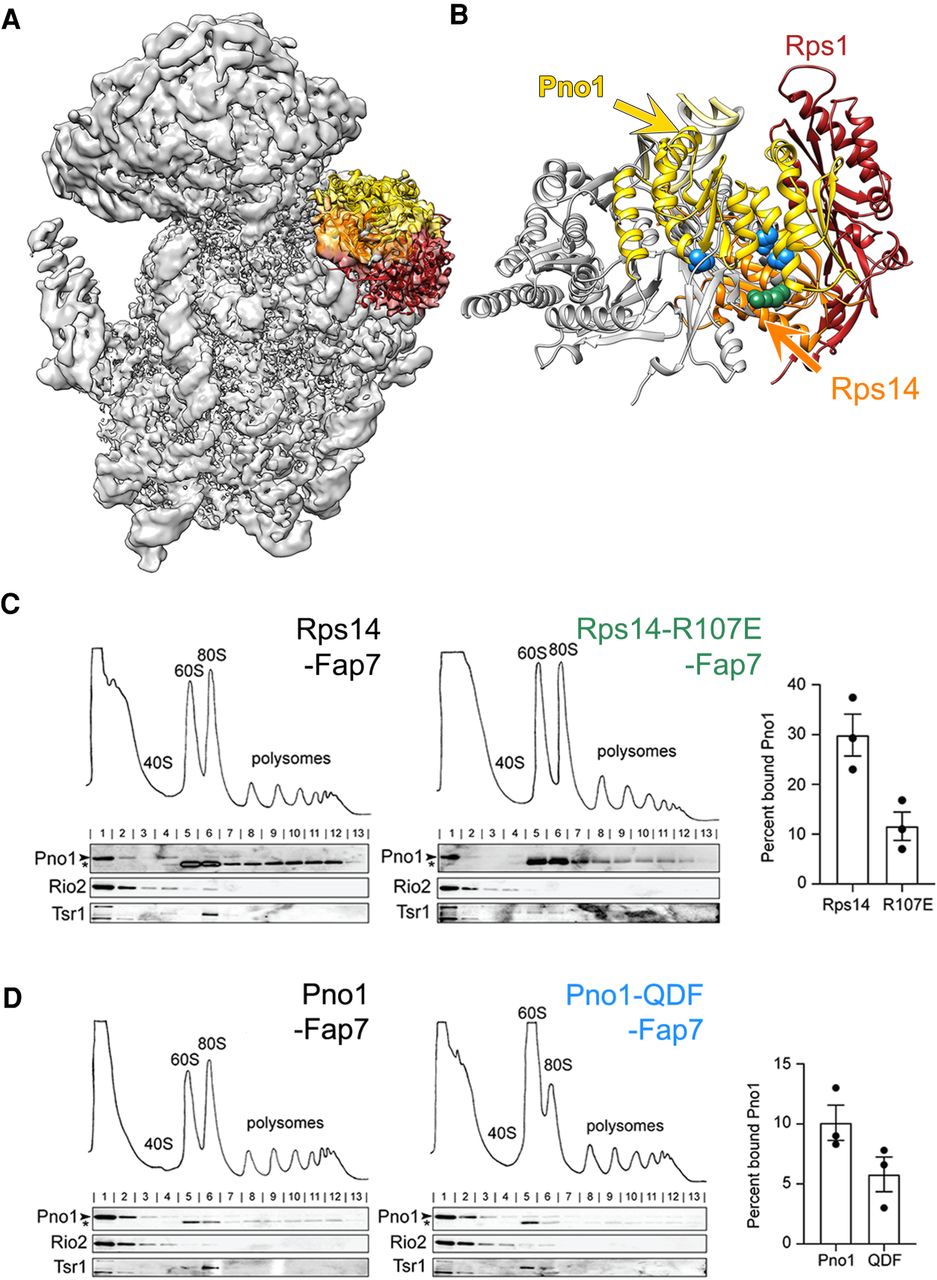
An opened pre-40S platform retains the Rps1•Rps14•Pno1 trimer. (A) After local classification at the platform, alignment, and local B-factor sharpening in Relion-3.0 (Zivanov et al. 2018), the dominant class has density corresponding to Rps1 (red), Rps14 (orange), and Pno1 (yellow) albeit not at their final positions. (B) In 80S-like ribosomes Rps1 (red), Rps14 (orange), and Pno1 (yellow) are shifted outwards relative to their positions in an earlier pre-40S intermediate (PDB ID 6FAI [Scaiola et al. 2018], Rps1, Rps14, and Pno1 in gray). The residues in Pno1-QDF (Q153E; D157R; F237A, blue) and Rps14-R107 (green) are at the interface between Pno1 and Rps14. (C) The indicated whole cell extracts were fractionated as in Figure 3 and analyzed by western blot (left). Bound Pno1 was calculated as the percent of Pno1 in fractions 4–13 compared to total Pno1 (right). Data are the average of three biological replicates and error bars indicate SEM. Note that the top band is Pno1, marked with an arrow, while the bottom band, marked with an asterisk, represents cross-reactivity. (D) The indicated whole cell extracts were fractionated as in Figure 3 and analyzed by western blot (left). Bound Pno1 was calculated as in C (right). Data are the average of three biological replicates and error bars indicate SEM.




