


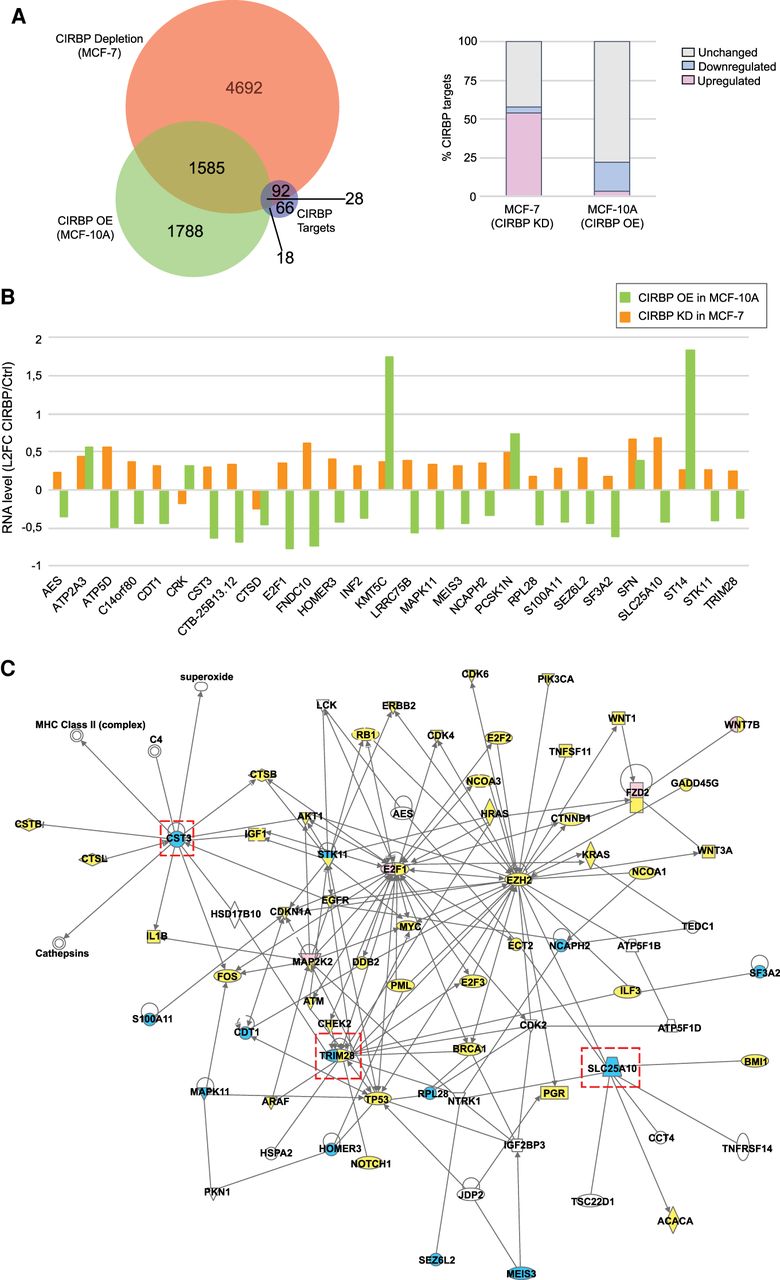
CIRBP regulates a network of breast cancer genes. (A) Differences in the transcriptomes of MCF-10A cells overexpressing CIRBP, and MCF-7 cells depleted of CIRBP, with their respective controls were determined by RNA-seq (experiments were performed in duplicate; threshold for significance, Pval < 0.05). The overlap between genes changing in both cell lines and the CIRBP high-confident target list is shown on the left. The direction of change in the high-confident target list is shown on the right. (B) Detail of the direction and magnitude of change of the 28 CIRBP targets overlapping in A. (C) Network analysis of CIRBP targets (see text for details). Yellow, known breast cancer gene; blue, CIRBP high-confident target; pink, CIRBP target identified in this study but excluded from the high-confident list. A few targets show two colors, indicative of their classification in two groups. Connections represent interactions at any reported level (i.e., protein–protein, protein–mRNA/DNA, activation); arrows represent activation while bars represent inhibition. Shapes of the nodes: vertical ellipse, transmembrane receptor; horizontal ellipse, transcription regulation; diamond, enzyme; square, cytokine; inverted triangle, kinase; vertical rectangle, G-protein coupled receptor; horizontal rectangle, ligand-dependent nuclear receptor; trapezoid, transporter; simple circle, other; concentric circle, group or complex. Dashed, red squares represent CIRBP targets that are highly interconnected in the network and which were chosen for independent validation.




