


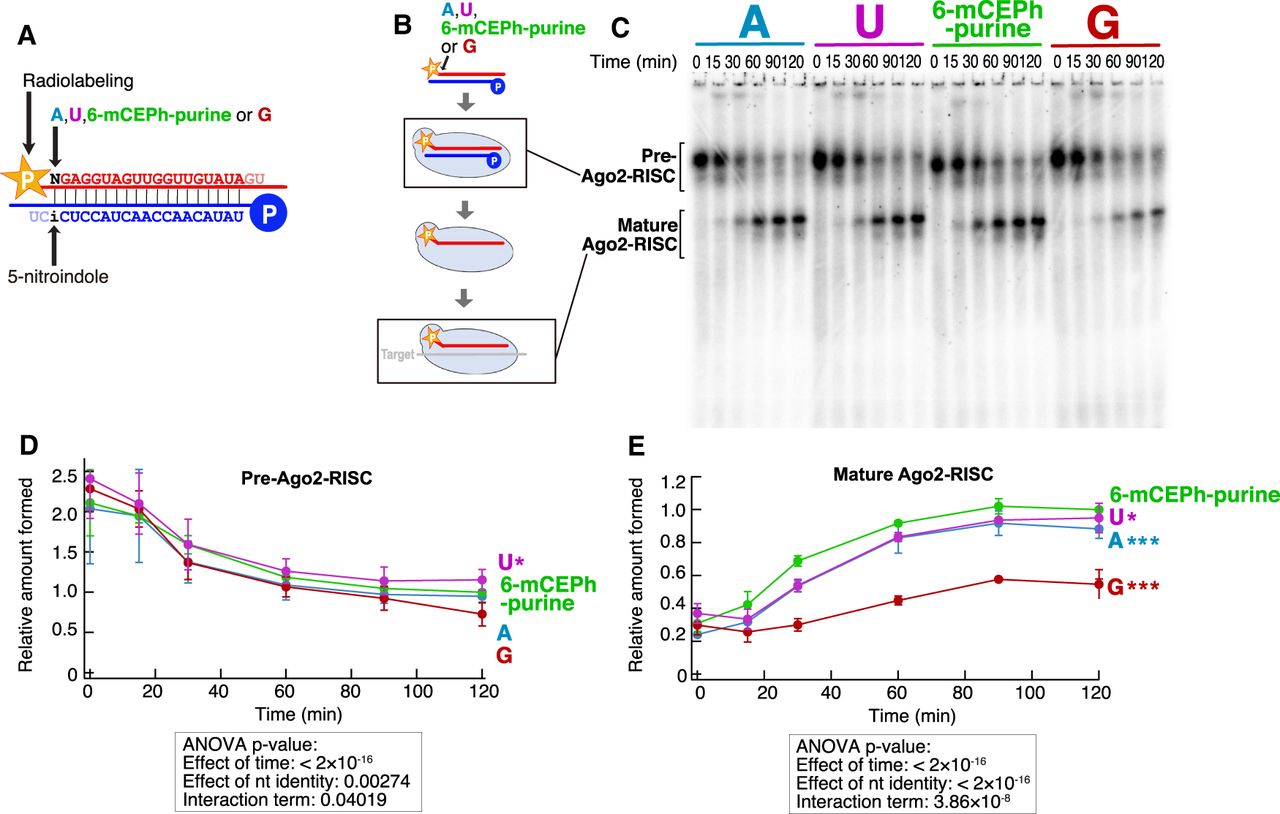
The 6-mCEPh-purine modification improves mature RISC formation. (A) Four siRNA duplexes used in this set of experiments. Each of them bore different nucleotides (A, U, 6-mCEPh-purine or G) at the 5′ end of the guide strand and 5-nitroindole at position 19 of the passenger strand. The guide strand was radiolabeled at the 5′ monophosphate, whereas the passenger strand had a nonradiolabeled 5′ monophosphate. (B) Scheme of RISC assembly. A nonradiolabeled, uncleavable target oligonucleotide complementary to the guide strand was added to trap mature Ago2-RISC. (C) A representative result of the native agarose gel assay. (D,E) Quantification of pre-Ago2-RISC (D) and mature Ago2-RISC (E) formation. The quantified signals were normalized to the mature Ago2-RISC value of 6-mCEPh-purine at 120 min. The graphs show the average ± SD from three independent experiments using the same set of reagents. The ANOVA P-values are given in insets under the graphs. Note that the ANOVA P-value for pre-Ago2-RISC in D is imprecisely determined, because the distribution of residuals was slightly skewed toward higher values even after log-transformation. The results of pairwise comparison on the effect of 6-mCEPh-purine compared to natural nucleotides are indicated by asterisks (*) P < 0.05, (**) P < 0.005, (***) P < 0.0005. The detailed results of statistical analyses are summarized in Supplemental Table 1.




