


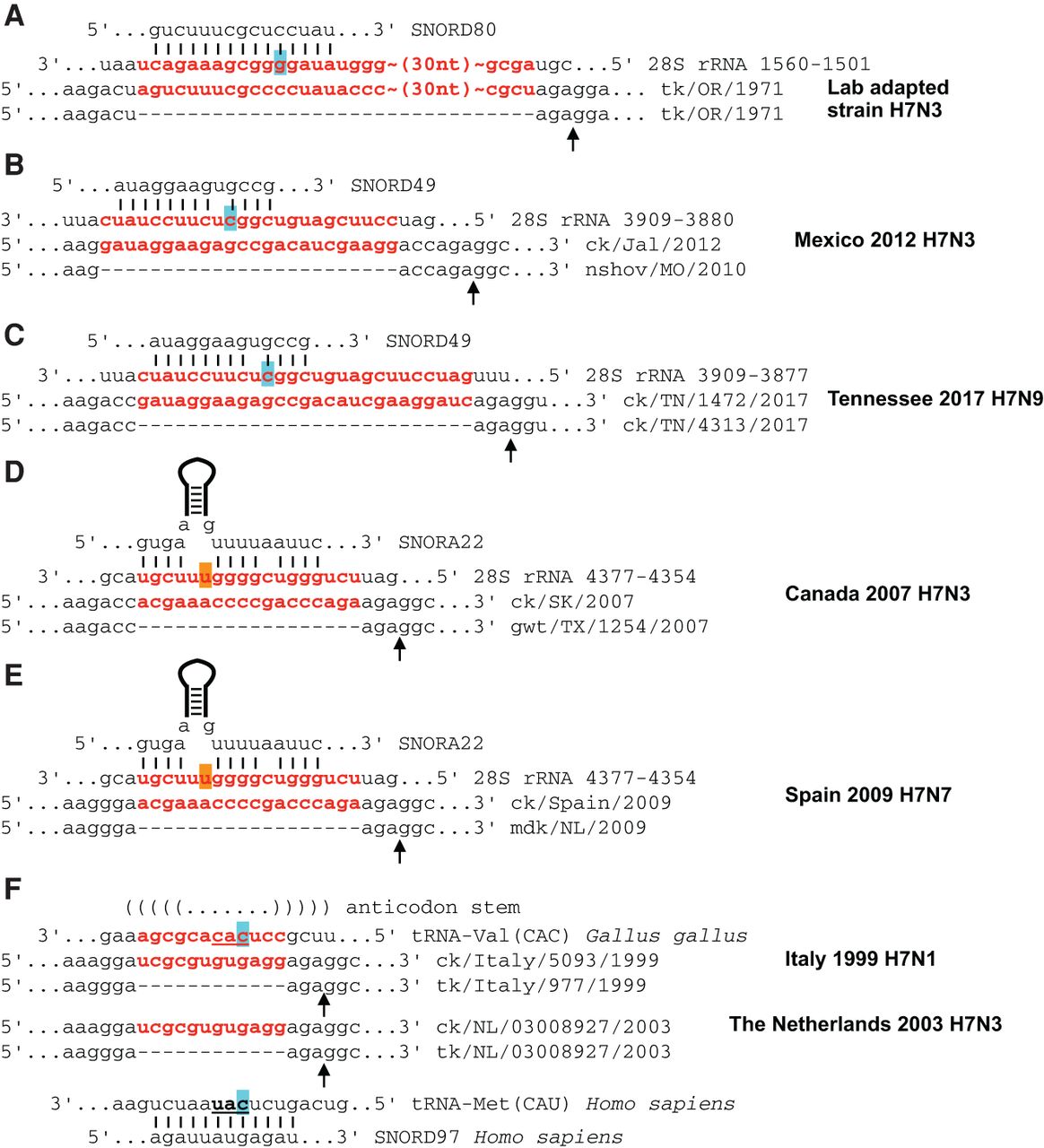
Recombination of the influenza virus H7 HA RNA with host RNAs. (A–E) The insertions in the HA segments created by recombination with 28S rRNA and the binding sites of snoRNAs near the recombination sites. The HA RNA sequences from HPAI strains (Khatchikian et al. 1989; Banks et al. 2001; Berhane et al. 2009; Iglesias et al. 2010; Maurer-Stroh et al. 2013; Lee et al. 2017; Beerens et al. 2020) are aligned to HA sequences of most closely related LPAI viruses. The apical stem between two parts of the SNORA22 antisense element is shown schematically. (F) The 12-nt sequence inserted in the Italian H7N1 (1999) and Dutch H7N3 (2003) HPAI strains is complementary to the region encompassing anticodon of chicken tRNA-Val. Base pairs of the tRNA-Val anticodon stem are shown with bracket view. Anticodon nucleotides are underlined. Chicken tRNA-Val is aligned to human tRNA-Met in order to illustrate the location of the C/D box snoRNA binding site in the tRNA-Met (Vitali and Kiss 2019). Inserted sequences and their complements in 28S rRNA and tRNA are shown in red. Locations between the codons for conserved amino acids Arg and Gly, corresponding to the HA0 polyprotein cleavage sites, are indicated by arrows. The 2′-O-methylated nucleotides are labeled with cyan, the pseudouridylated uridines with orange. For strain abbreviations, see Materials and Methods.




