


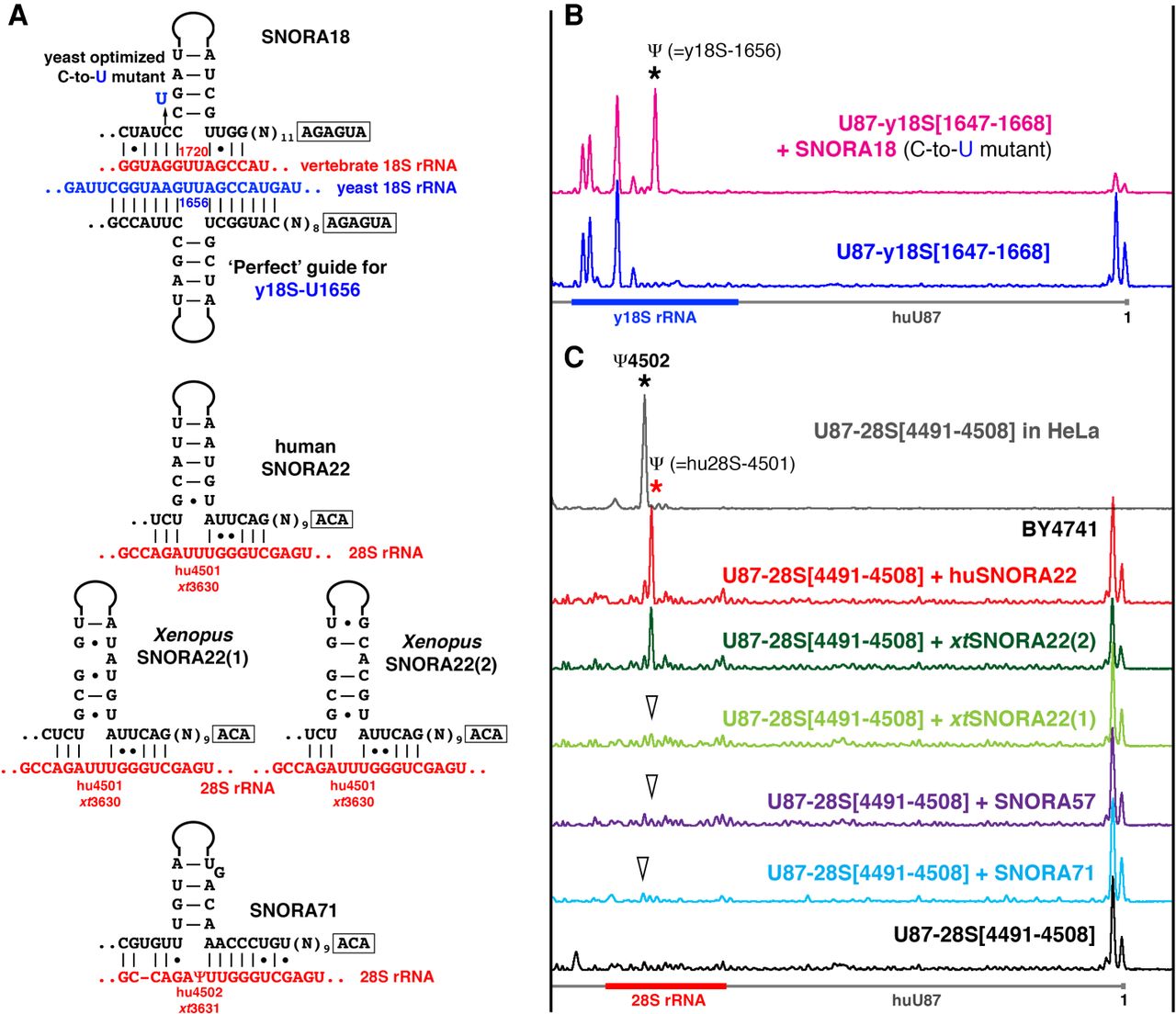
(A) Predicted base-pairing of SNORA18, SNORA22, and SNORA71 with 18S rRNAs at position 1720 and with 28S rRNA at positions 4501 and 4502, respectively. (B,C) Pseudouridylation of artificial substrate RNAs in yeast cells. (B) Yeast optimized SNORA18 (C-to-U-mutant) can induce predicted pseudouridylation in a fragment of yeast 18S rRNA [1647–1668 nt] inserted in U87 RNA (pink trace, star). Expression of the artificial substrate RNA U87-y18S[1647–1668] alone used as a negative control (blue trace). (C) When expressed in yeast cells, human SNORA22 (red trace, red star) and Xenopus SNORA22(2) (dark green trace) can induce pseudouridylation of position 4501 in a 28S rRNA fragment [4491–4508 nt] inserted in U87 RNA. Xenopus SNORA22(1) (light green trace, arrowhead) and SNORA57 (dark blue trace, arrowhead) do not show modification activity on the same substrate RNA. SNORA57 activity on 28S-4501 was predicted by Kehr et al. (2014); for the proposed base-pairing see Supplemental Figure S1. Note that two copies of Xenopus SNORA22—functional and nonfunctional—differ only in their upper stem structures. In human, 28S rRNA position 4502 is pseudouridylated, and this position becomes modified in the artificial substrate RNA expressed in HeLa cells (top gray trace, black star). SNORA71 can base-pair with 28S rRNA at position 4502 (A). However, when it was tested in yeast, SNORA71 could not induce this modification in the artificial substrate RNA (light blue trace, arrowhead).




