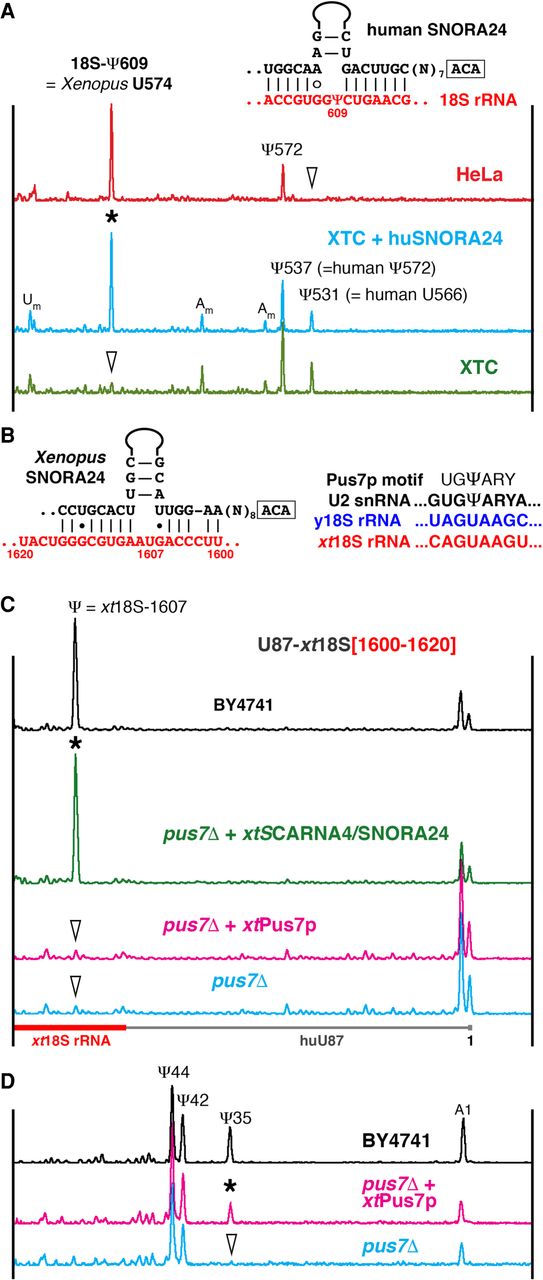
Testing SNORA24 modification guide activities. (A) Mapping of pseudouridines in 18S rRNA from human HeLa cells (red trace) and Xenopus laevis XTC cells (green and blue traces) using fluorescent primer extension. Peaks corresponding to reverse transcription termination at modified positions are indicated. Arrowheads point to unmodified positions. Ectopic expression of human SNORA24 in XTC cells induces pseudouridylation of Xenopus 18S rRNA at position 574, equivalent to human 18S-609 (blue trace, star). Postulated base-pairing between human SNORA24 and 18S rRNA shown in the top right corner. (B) Predicted base-pairing between Xenopus SNORA24 and 18S rRNA (left) and Pus7p recognition motif (right). (C) Modification of the artificial substrate RNA specific for xtSNORA24 (U87-xt18S[1600–1620]) in wild type BY4741and pus7Δ mutant yeast strains. The position corresponding to xt18S-1607 in the artificial substrate RNA is pseudouridylated in wild type (black trace) and in the pus7Δ strain that expresses xtSNORA24 (green trace, star). This position is not modified in the pus7Δ strain itself (blue trace, arrowhead) and in the pus7Δ strain that expresses Xenopus Pus7p (pink trace, arrowhead). Note, that in a fragment of 18S rRNA [1600–1620], yeast Pus7p recognizes a sequence different from the consensus UGΨAR (Urban et al. 2009; Carlile et al. 2014; Schwartz et al. 2014): It contains A instead of unvarying U at −2 position, AGΨAA (B). (D) Pseudouridylation of yeast U2 snRNA in wild type (black trace) and mutant pus7Δ strains (blue and pink traces). Expression of Xenopus Pus7p in the pus7Δ yeast strain rescues pseudouridylation of U2 snRNA at position 35 (pink trace, star).