


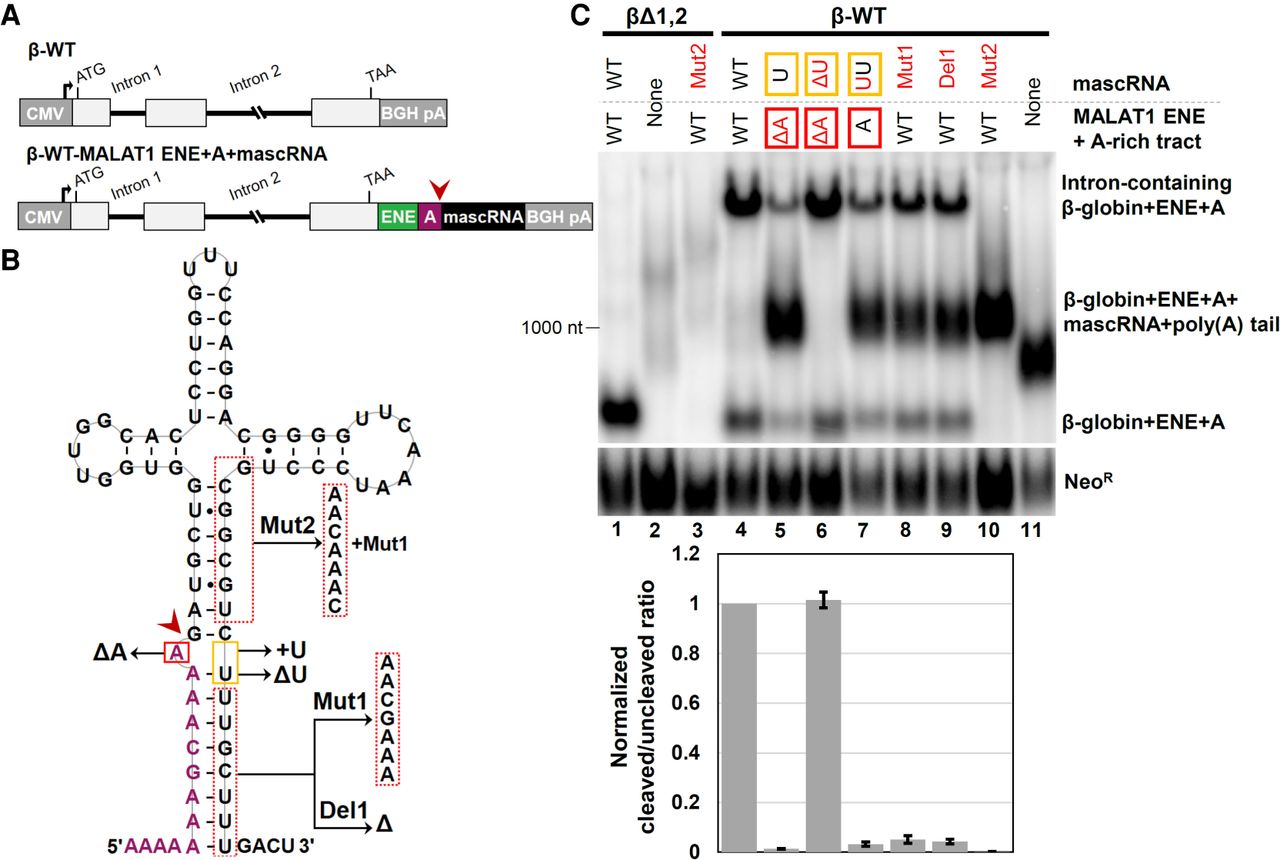
Predicted base-pairing interactions between the A-rich tract and the mascRNA 3′ trailer contribute to the 3′-end maturation of reporter transcripts. (A) Schematics of the intron-containing β-globin (β-WT) reporter constructs with or without the MALAT1 ENE (green), the A-rich tract (purple), and the mascRNA (black). Introns are represented by black lines; exons are represented by gray boxes; the RNase P cleavage site in the wild-type MALAT1 is marked by an arrowhead. (B) Predicted tRNA-like secondary structure for mascRNA with an extended acceptor stem formed by the A-rich tract (purple) and the mascRNA 3′ trailer. Boxed nucleotides were mutated. Mut2 was created from Mut1 by mutating the additional nucleotides shown in the acceptor stem. (C) Northern blot analysis of β-globin and NeoR RNAs (top) and quantitation (bottom) examined the effect of the extended stem on reporter transcript maturation. Disruption of the extended stem or elimination of the bulged nucleotide upstream of the RNase P cleavage site abolished efficient maturation of the reporter transcript. Maturation efficiency is the ratio of the cleaved to uncleaved transcripts normalized to the wild-type ratio. Cleaved transcripts are the sharp β-globin bands (top and the bottom), while uncleaved transcripts are the more diffuse polyadenylated β-globin bands appearing in the middle. Representative data are the average of at least three independent experiments ± SD.




