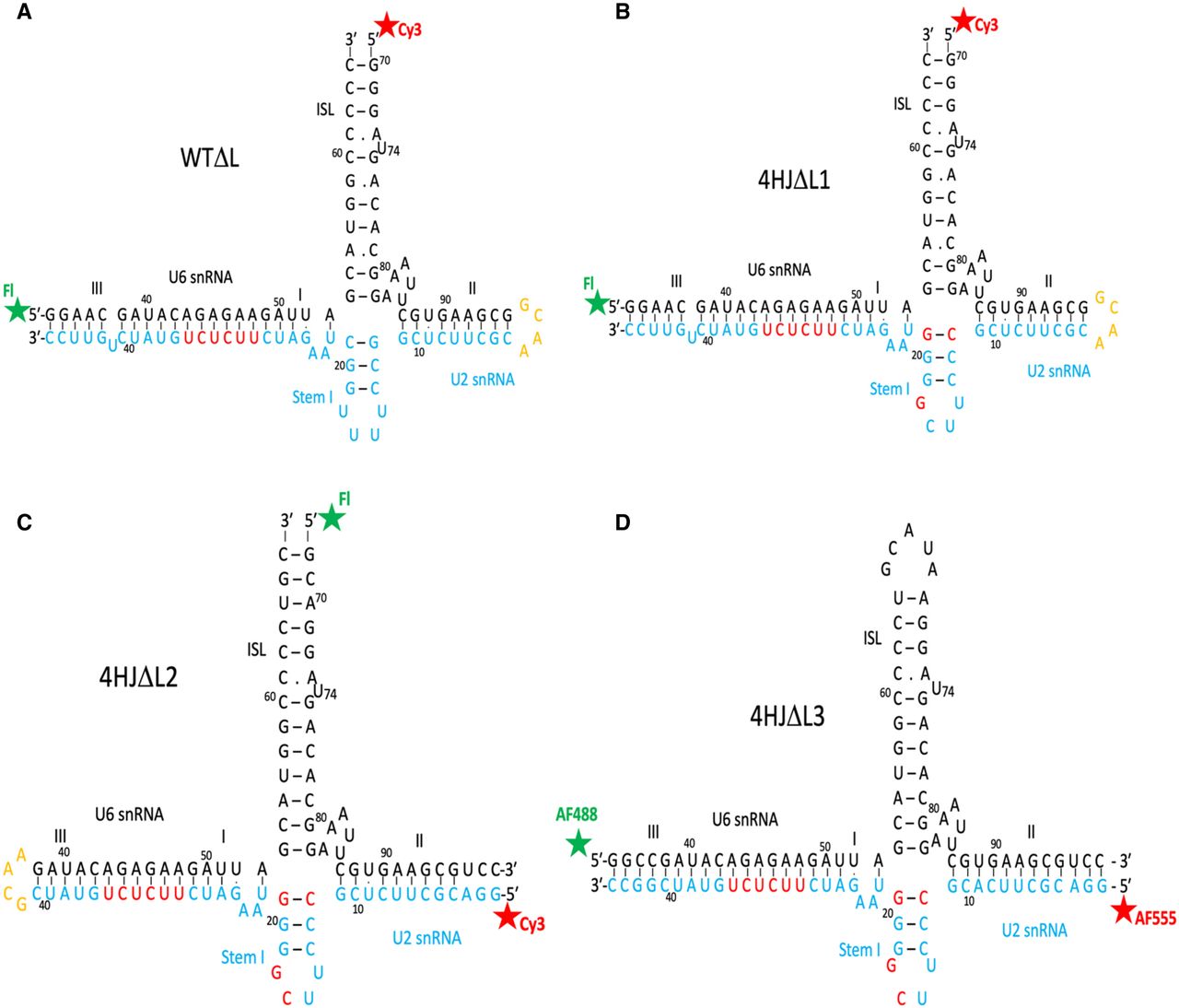

Constructs representing the human U2–U6 snRNA complex used in these experiments. Modifications to helix length including truncation, deletion, or addition of hairpin loops to create “chimeric” strands, or nucleotide changes to favor base pairings, are described in Materials and Methods. Constructs are all depicted in the four-helix secondary structure; the AGC catalytic triad corresponds to nucleotides A53G54C55 of U6 snRNA. (A) Wild-type junction in which the ACAGAGA loop is “closed” by pairing with a complementary sequence (shown in red), with fluorescein as the Donor (D; Fl) and Cy3 as the Acceptor (A) on termini of helix III and U6 ISL, respectively (WTΔL). (B) Mutations in Stem I favor the four-helix conformer (individual nucleotide changed in red), also with a “closed” ACAGAGA loop and dyes on helix III and U6 ISL (4HJΔL1). (C) Four-helix mutant with “closed” ACAGAGA loop, and Fl and Cy3 dyes on termini of U6 ISL and Helix II, respectively (4HJΔL2). (D) Four-helix mutant with “closed” ACAGAGA loop with AF488 (D) and AF555 (A) dyes on termini of Helix III and Helix II, respectively (4HJΔL3). (E) Four-helix mutant with “closed” ACAGAGA loop with AF488 and AF555 dyes on Helix III and Stem Loop I, respectively (4HJΔL4). (F) Wild-type U2–U6 junction with wild-type ACAGAGA loop, and Fl and Cy3 on termini of Helix III and U6 ISL, respectively (WT). (G) Four-helix mutant with ACAGAGA loop, with Fl and Cy3 dyes on termini of Helix III and U6 ISL, respectively (4HJ). (H) The proposed three-helix junction conformer without an ACAGAGA loop (3HJ).