


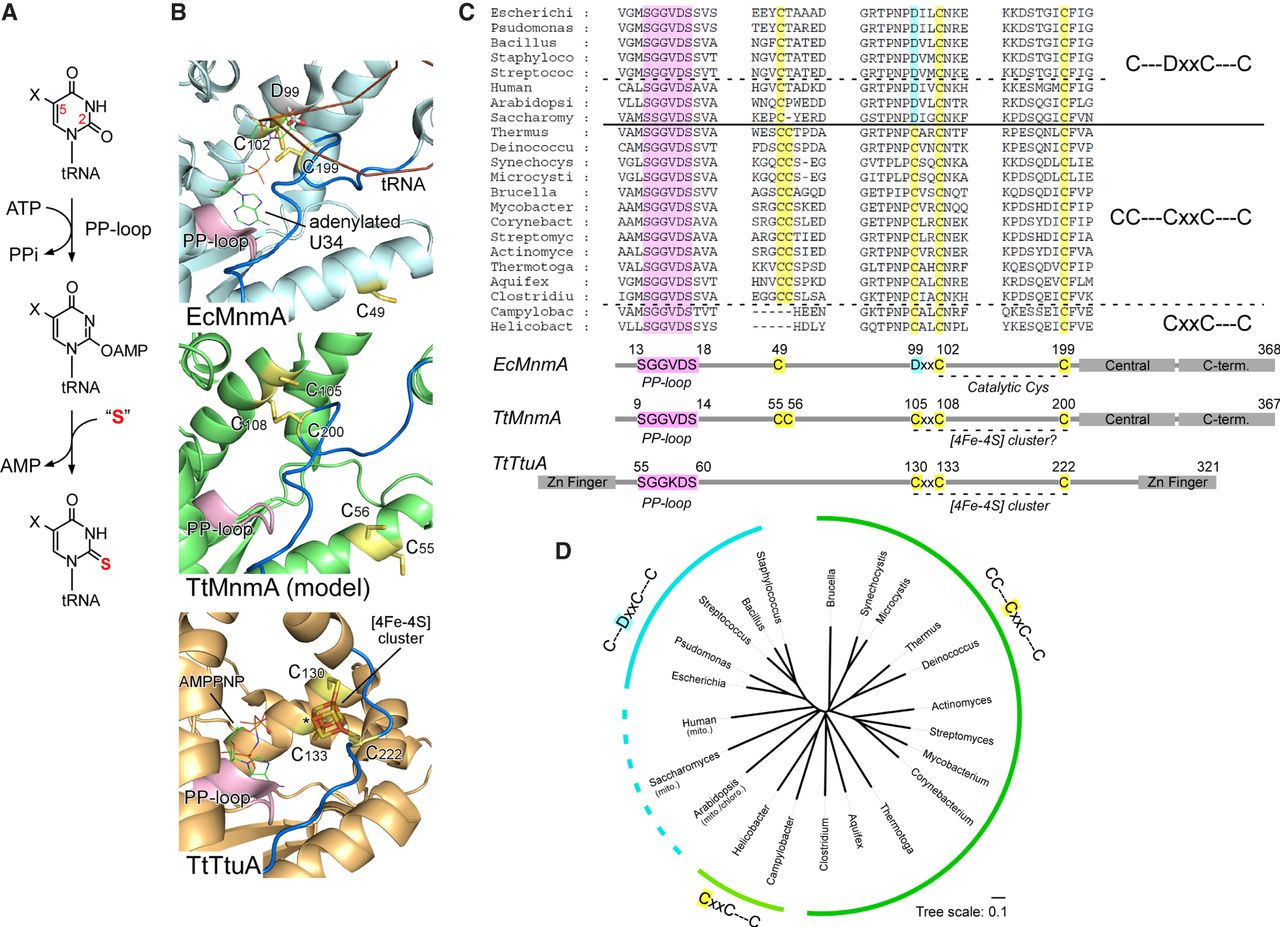
Two types of MnmA tRNA s2U34 sulfurtransferases. (A) Reaction mechanism of MnmA. The PP-loop motif in MnmA is involved in the formation of an adenylated intermediate, and subsequent nucleophilic attack by activated sulfur (depicted as “S”) generates s2U and releases AMP. (B) Structures of the catalytic centers of representative RNA sulfurtransferases. Structures of EcMnmA (PDB: 2deu), TtMnmA model generated by SWISS-MODEL, and TtTtuA (PDB: 5b4e) were rendered by the PyMol program (DeLano Scientific). Important residues and ligands in these proteins are depicted and labeled. The Fe with a free coordination site in TtTtuA is labeled with an asterisk (*). The flexible loops with a cysteine residue are colored blue. (C) Conserved sequence motifs in the catalytic domains of MnmAs from several representative bacteria and eukaryotes. These sequences were aligned with the CLUSTAL X2 program (Larkin et al. 2007) and visualized with the GeneDoc program. The complete alignment is shown in Supplemental Figure S1. Schematic representation of the conserved motifs in the catalytic domains of EcMnmA, TtMnmA, and TtTtuA is depicted below the alignment, along with other domains. (D) Phylogenic tree of several MnmAs drawn with the CLUSTAL X2 and iTOL programs (Letunic and Bork 2016) based on the sequence alignment in C.




