


Kiyoshi Nagai (1949–2019)
Kiyoshi Nagai, group leader at the MRC Laboratory of Molecular Biology Cambridge, UK, sadly passed away on September 27, 2019 at the age of 70.
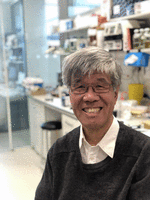
Kiyoshi grew up in Osaka, Japan and was trained as a biophysicist at Osaka University. He received his Doctor of Philosophy in 1977 under the supervision of Professor Hideki Morimoto, working on allosteric effects in hemoglobin. During his PhD work, Kiyoshi spent 18 months at the LMB in the group of Max Perutz. After four years as Assistant Professor at Nara Medical School, Japan, Kiyoshi returned to the LMB, to which he devoted the remainder of his scientific life. In 1984 he was appointed as a group leader in the Structural Studies division, and was joint head of this division from 2001 to 2010.
Kiyoshi was a brilliant biophysicist, who pioneered the structural biology of the spliceosome, the molecular machine that catalyzes the removal of introns from nuclear pre-mRNAs. The major building blocks of the spliceosome—the snRNPs U1, U2, U4/U6, and U5, and numerous additional proteins—assemble anew onto each pre-mRNA intron that needs to be spliced out. This follows a sophisticated assembly-line process, in which a succession of distinct RNP complexes is generated during each round of pre-mRNA splicing. Thus the spliceosome is an extremely dynamic molecular machine; its composition and structure change continuously during its life cycle, presenting a tremendous challenge for determining and understanding its structure. Kiyoshi tackled this demanding task with amazing perseverance, creativity, and scientific rigor. He published the first crystal structure of the RNA recognition motif (RRM) of the U1A protein in 1990, which was followed soon after by the crystal structures of the U1A RRM in complex with the stem–loop II of U1 snRNA and of the ternary complex of the U2 proteins A′ and B″ together with the U2 snRNA stem–loop IV. Collectively, these structures provided important insight into a fascinating mechanism of RNA recognition. At the same time, these successes catapulted Kiyoshi to prominence in the growing and exciting field of RNA–protein interactions.
In a tour de force, Kiyoshi and his group succeeded in expressing recombinantly several pairs of the seven Sm proteins that make up the core of the spliceosomal snRNPs, and by solving the structure of the SmD1–SmD2 and SmB–SmD3 protein complexes, in 1999 Kiyoshi came up with the ingenious idea that the seven Sm proteins would form a doughnut-shaped Sm core structure. Some ten years later, by solving the structures of the U4 snRNP core domain and that of recombinantly produced U1 snRNP, his group not only showed that this model was correct, but also that the Sm site RNA is threaded through the inner hole of the Sm doughnut, revealing a novel type of protein–RNA interaction.
Kiyoshi's group was also at the forefront of solving the structure of the U5 snRNP proteins. For example, they crystallized the large domain of Prp8 in 2013, the major scaffolding protein of the spliceosome that contacts all the reactive sites of the pre-mRNA intron in the spliceosome. This structure also revealed the first glimpse into which part of Prp8 could be located close to the site on the spliceosome that accommodates the catalytic RNA.
A few years ago, a “resolution revolution” took place in the cryo-EM field, thanks mainly to dramatic improvements in detector hardware and computer software. This allowed the reconstruction of high-resolution 3D structures of large molecular machines, even those as dynamic as the spliceosome. A few years ago, Kiyoshi was the first to publish cryo-EM structures of the S. cerevisiae U4/U6.U5 tri-snRNP, the largest building block of the spliceosome, which in turn provided insight into many other novel protein–protein and protein–RNA interactions. Kiyoshi then went on to publish the cryo-EM structures of catalytically active yeast spliceosomes that were stalled immediately after the first catalytic step and before the second catalytic step, as well as a postcatalytic spliceosome, in which the pre-mRNA intron was excised and exons were ligated. Among other things, these structures provided insight into the dramatic remodeling of the spliceosome during the catalytic phase, and showed that the spliceosome indeed uses a single catalytic center for carrying out both catalytic steps of pre-mRNA splicing. Very recently, Kiyoshi also determined the structure of earlier assembly stages of the yeast spliceosome and a human P complex, which revealed the likely roles of metazoan-specific splicing factors in the ligation process.
Although my group and that of Dr. Yigong Shi (at Tsinghua University, Beijing) were Kiyoshi's competitors, publishing additional and/or complementary cryo-EM structures of various spliceosomal snapshots from yeast and human, Kiyoshi never let this get in the way of our personal and scientific relationships. Our interactions remained characterized by friendship, openness, and mutual respect, which speaks volumes about Kiyoshi's character and human stature. Collectively, within an amazingly short period, a long-cherished dream that we all shared has come true: We have not only obtained an atomic-level model of the spliceosome's catalytic center, but have also gained insight into the striking gymnastics that many of the spliceosomal factors perform during the splicing cycle. Kiyoshi's structural work was instrumental in achieving this long sought after goal in the pre-mRNA splicing field. It is therefore all the more tragic that Kiyoshi passed away at the height of his scientific career and could enjoy the beauty of his wonderful discoveries for only such a short time.
With Kiyoshi's passing, the RNA community has lost not only a brilliant and inspiring scientist, but also a wonderful colleague, who was thoughtful, conscientious, generous, and highly dedicated to serving the scientific community. More than this, Kiyoshi was also a respected mentor who cared tremendously about the training and future careers of his students and post-docs. Indeed, only about a week before Kiyoshi passed away he sent me an e-mail asking me to write a letter in support of an application by one of his post-docs.
We will miss Kiyoshi greatly, but we will always remember his smiling face, his warm personality, and his respect and support for others.




