


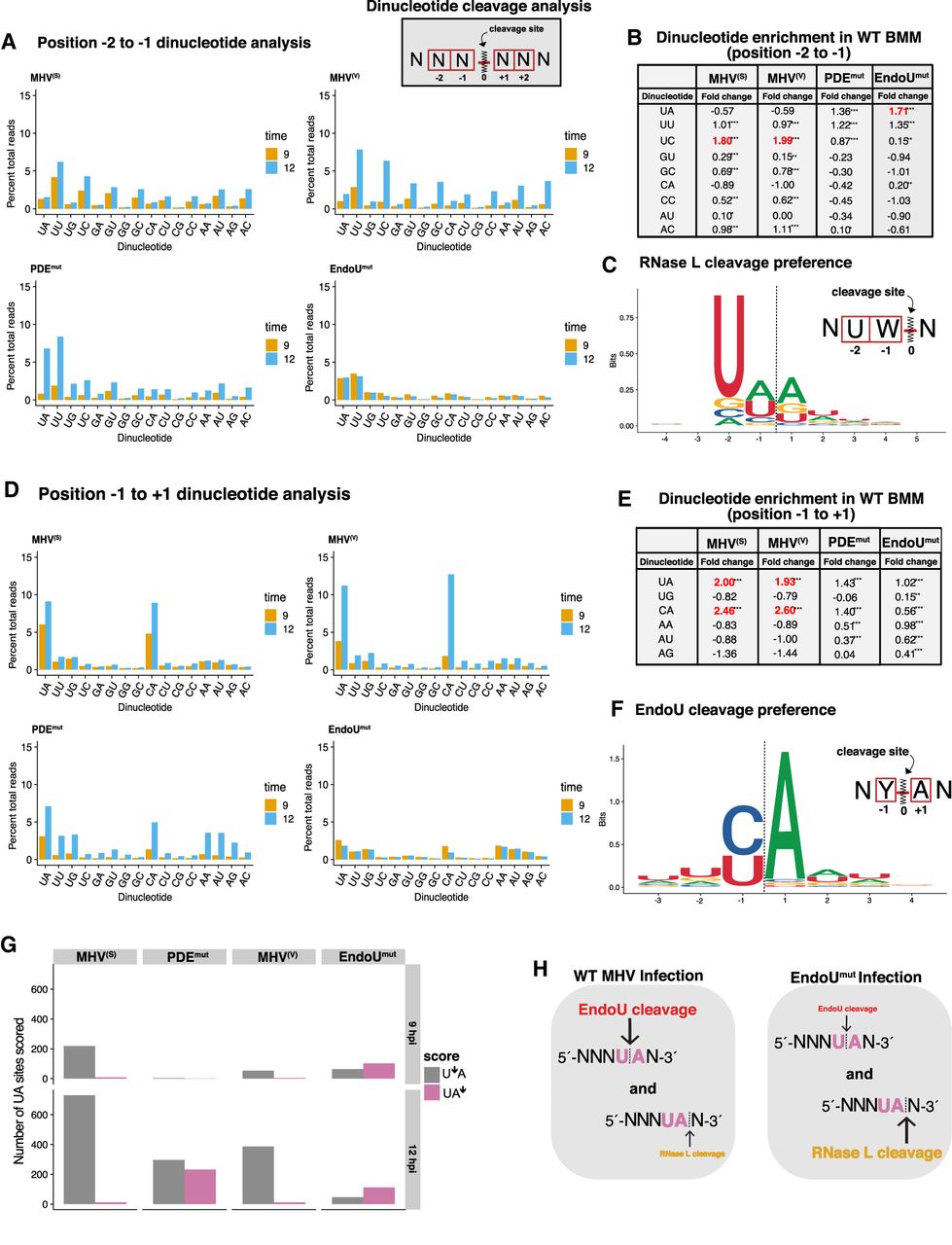
Sequence specificity of cleavage sites in MHV RNA. (A,D) Dinucleotide specificity analysis for cleavage in MHV RNA by percent total cDNA reads captured at each 3′-dinucleotide in wt BMM at 9 and 12 hpi for (A) Dinucleotide analysis for positions −2:−1 and (D) dinucleotide analysis for positions −1:+1 from captured cleavage position (0 position). (B,E) Dinucleotide enrichment for dinucleotide positions from −2:−1 (B) or −1:+1 (E) for each condition of viral infection at 12 hpi in wt BMM by comparing the frequency of dinucleotide capture in experimental conditions to the frequency of occurrence for each dinucleotide in the MHV RNA sequence (control). Significant enrichment was determined by adjusted P-value (q) for fold change (log2[experiment/control]). <0.02*, <0.0001**, <1 × 10⁸***. Only dinucleotides with positive enrichment are shown. (C,F) Sequence logos for the six bases surrounding the cleavage site for position −2:−1 (C) or −1:+1 (F). Logos generated from the top 1% of either RNase L (215 sites) or EndoU-dependent cleavages (306 sites). (G) UA cleavage scoring analysis. All UA sequences in the MHV RNA with ≥30 cyclic phosphate counts in either the UA↓ or U↓A cleavage position were compared by calculating the ratio of normalized counts (UA↓ counts/U↓A counts). Ratios >1 were scored as UA↓ (RNase L) sites and ratios <1 were scored as U↓A sites (EndoU) and total number of scored sites for either position are shown for each condition of viral infection in wt BMM at 9 and 12 hpi. (H) Model of EndoU and RNase L interaction at UA sites in MHV RNA.




