


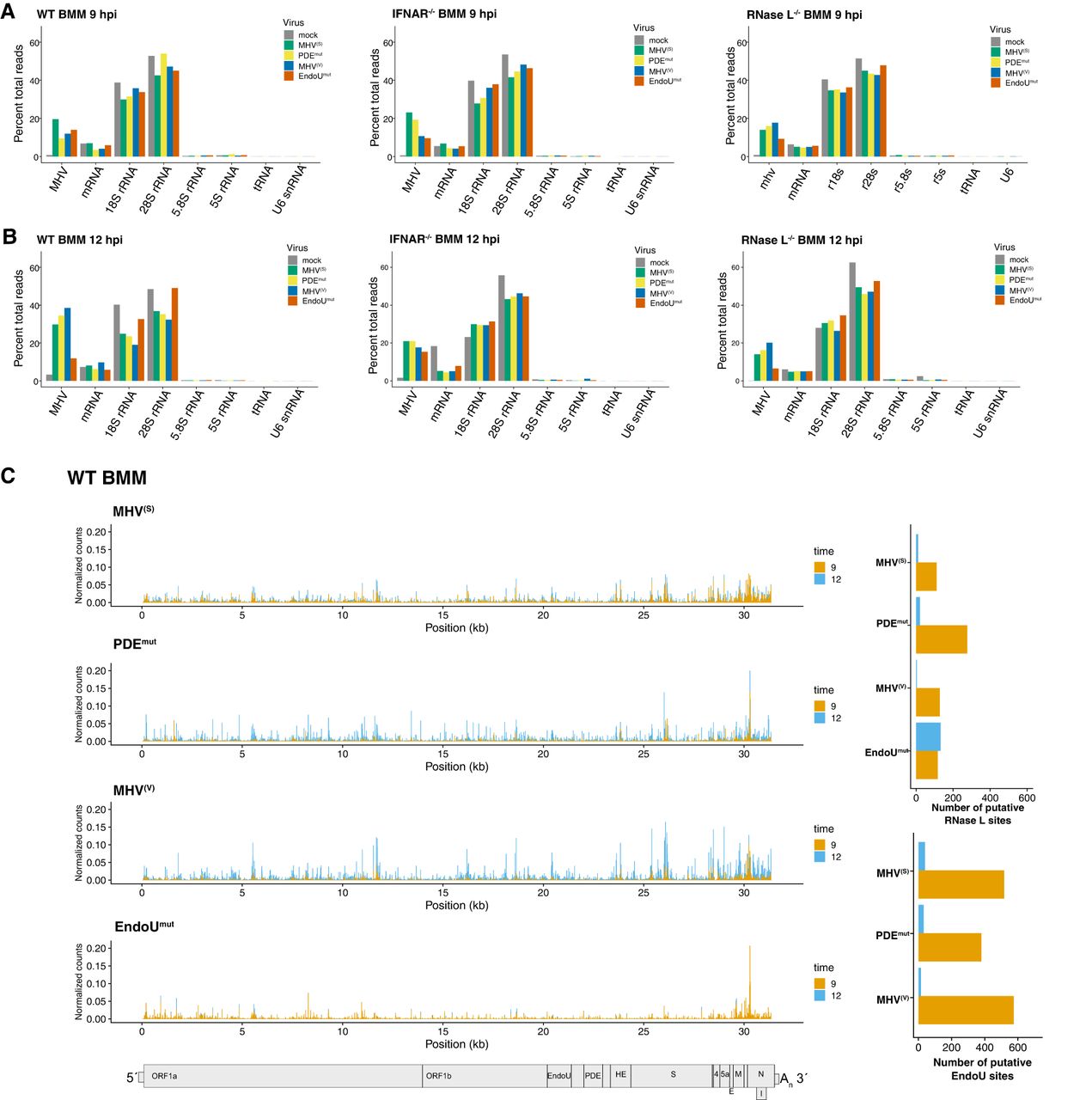
Endoribonuclease cleavage in host and viral RNAs. (A,B) Relative amounts of endonucleolytic cleavage in host and viral RNAs. Normalized cyclic phosphate cDNA reads (reads at each position/total reads in library) mapped to host and viral RNAs at 9 and 12 hpi in wt, IFNAR−/−, and RNase L−/− bone marrow macrophages (BMMs). (C) Frequency and location of cleavage sites in MHV RNA. Normalized cyclic phosphate cDNA reads captured at each position along the MHV genomic RNA at 9 and 12 hpi from MHV(S)-, MHV(V)-, PDEmut-, and EndoUmut-infected wt BMM. Putative cleavage sites attributed to EndoU or RNase L were calculated from RNase L– or EndoU-dependent signal generated by subtracting signal from each captured position that occurs in the absence of either enzyme (RNase L−/− BMM or during EndoUmut infection). These data were then filtered for sites with reads representing at least 0.01% of total reads in the library. At each of these positions, the log2-fold change in signal when either RNase L or EndoU were absent was calculated and sites with ≥2.5-fold change were designated putative RNase L or EndoU sites.




