


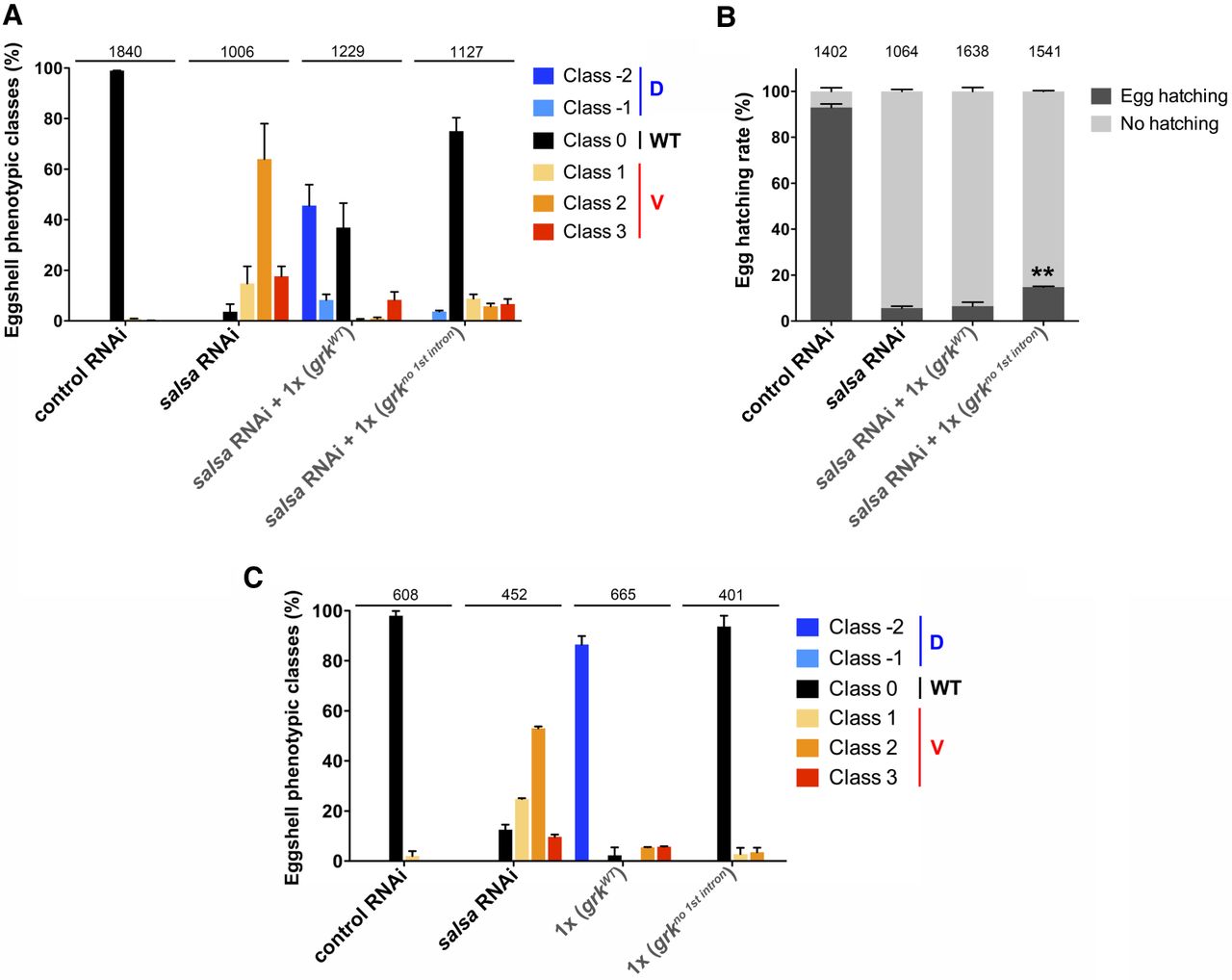
Deletion of the first intron of gurken rescues the D/V patterning defects of Salsa depletion. (A) Eggs laid by control females (mCherry RNAi) showed wild-type dorsal appendages (WT), whereas a significant proportion of the eggs laid by females whose germline was depleted for Salsa (nanos-Gal4 and salsa RNAi-2) showed eggshell ventralization (V), with highly abnormal (fused or partially fused) dorsal appendages (classes 1 and 2). Expression of a genomic construct of gurken with its own endogenous promoter, with (grkWT) or without the transcript first intron (grkno 1st intron), suppressed the eggshell ventralization defects of eggs laid by females whose germline was depleted for Salsa (salsa RNAi-2). Suppression of grkno 1st intron was significantly better than grkWT, with a higher frequency of wild-type eggshells (class 0). Number of eggs scored for each experiment is indicated above the bar plot and is the sum of two independent experiments. (B) Control females (mCherry RNAi) are fertile (egg hatching), whereas a significant proportion of the eggs laid by females whose germline was depleted for Salsa (nanos-Gal4 and salsa RNAi-2) did not hatch. While expression of one copy of a genomic construct of wild-type gurken (grkWT) did not rescue fertility, expression of one copy of a similar genomic construct of gurken without the transcript first intron (grkno 1st intron) partially rescued the fertility defects after Salsa depletion (salsa RNAi-2), (**) P = 0.0053; t-test analysis. Number of eggs scored for each experiment are indicated above the bar plot and are the sum of two independent experiments. (C) Expression of a genomic construct of gurken (grkWT) in an otherwise wild-type genetic background (1× grkWT; three copies of gurken: two endogenous and one corresponding to the genomic transgene) induced a significant eggshell dorsalization (D) (classes −2 and −1). Eggshell dorsalization was not observed after expression of a genomic construct of gurken without the first intron of gurken mRNA (1× grkno 1st intron). Number of eggs scored for each experiment is indicated above the bar plot and is the sum of two independent experiments. For quantification of eggshell dorsal appendages defects, the observed phenotypes were categorized in six different phenotypic classes based on the eggshell dorsal appendages. Class 0 corresponds to wild-type eggshell dorsal appendages (WT). Eggshell ventralization (V) of the eggshells corresponds to classes 1 to 3. Eggshell dorsalization (D) corresponds to classes −1 and −2. Class 0 (wild-type dorsal appendages): two individualized dorsal appendages); class 1: dorsal appendages only fused at bottom; class 2: fused dorsal appendages—spindle phenotype; and class 3: short eggs (dumpless-like phenotype) without or with extremely short dorsal appendages. Class −1: corresponds to short eggs with dorsalized appendages; class −2: corresponds to a broad and thick crown of appendage material or a broad/fused appendage that covers the entire width of the eggshell. Examples of scored phenotypes are shown in Supplemental Figure S10.




