


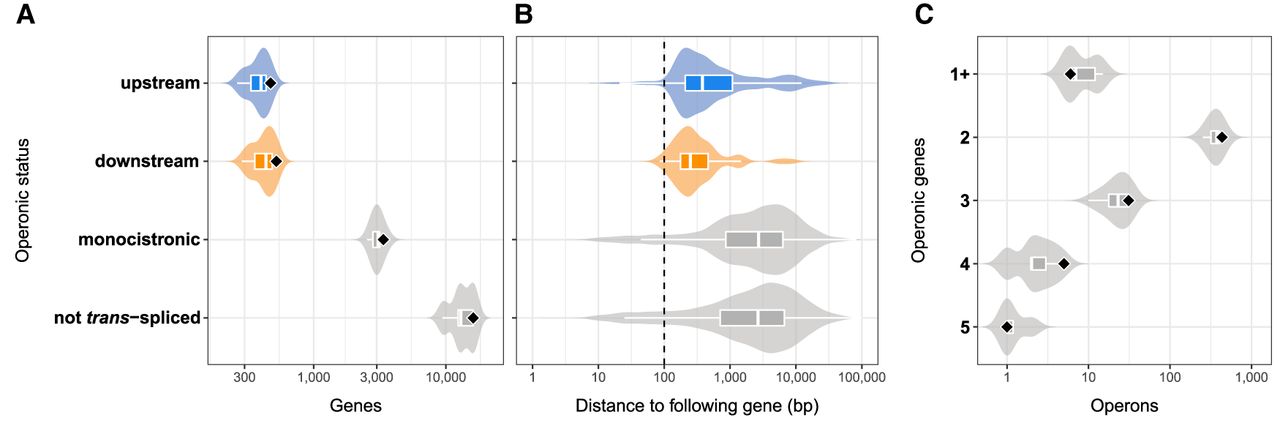
Genome-wide identification of T. spiralis operons using spliced leader usage patterns. (A) Numbers of expressed genes inferred to be upstream or downstream operonic, monocistronic (trans-spliced, but not operonic) or not trans-spliced. Plots show distributions (density and boxplot) across all 20 data sets; black diamonds indicate values for the most accurate data set (BRAKER + TRINITY, classified with 8 bp minimum match). (B) Distributions of physical intercistronic or intergenic distances for the most accurate data set (upstream—distance between first and second gene in operon; downstream—distance between downstream genes in same operon; monocistronic—distance of trans-spliced gene to following gene; not trans-spliced—distance of non-trans-spliced gene to following gene). (C) Numbers of inferred operons of particular sizes (1+ operons comprise a single SL2-type spliced leader trans-spliced gene without an upstream gene on the same genomic scaffold). Distributions are shown across all 20 data sets; black diamonds indicate values for the most accurate data set.




