


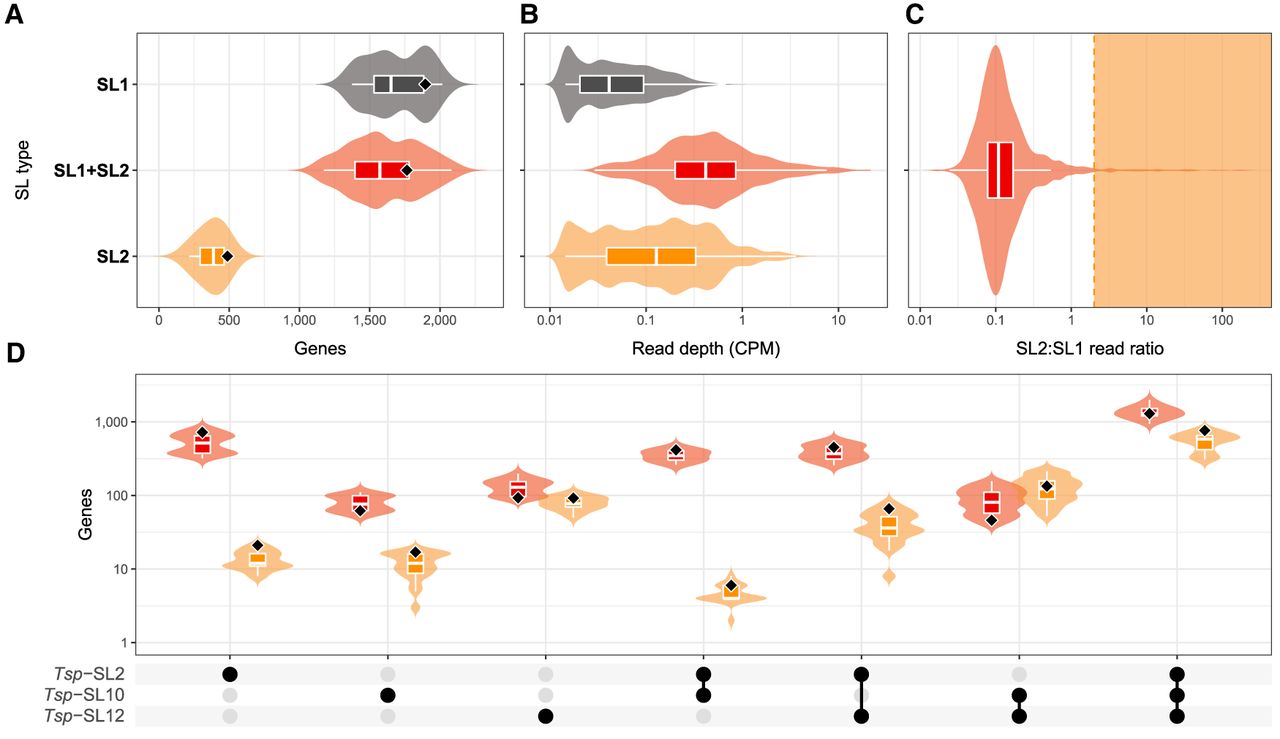
Genome-wide identification of differential usage of T. spiralis spliced leader RNAs. Genome-wide identification of T. spiralis genes receiving either exclusively SL2-type spliced leaders (Tsp-SL2, Tsp-SL10, and Tsp-SL12), SL1-type spliced leaders (all other Tsp-SLs), or a mixture of both types (“SL1 + SL2”). (A) Numbers of expressed genes receiving Tsp-SL reads. Plots show distributions (density and boxplot) across all 20 data sets in total (see main text); the black diamonds indicate the value for the most accurate data set (BRAKER + TRINITY, classified with 8 bp minimum match). (B) Distributions of Tsp-SL read depths (counts per million; CPM) using the most accurate data set (logarithmic scale). (C) Distribution of SL2:SL1 read-depth ratio in genes receiving both SL1- and SL2-type spliced leaders, using the most accurate data set (logarithmic scale). Genes with ratio >2 (orange shaded range of the distribution) were considered SL2-type genes for operon prediction consistent with observations from known benchmark operons (Fig. 2). (D) Distributions of gene numbers among “SL1 + SL2”-type (red) and “SL2”-type (orange) genes receiving combinations of Tsp-SL2, Tsp-SL10, and Tsp-SL12 spliced leaders, across all 20 data sets (black diamonds indicate value for the most accurate data set). The x-axis represents all possible intersections among the three Tsp-SLs as a combination dot matrix.




