


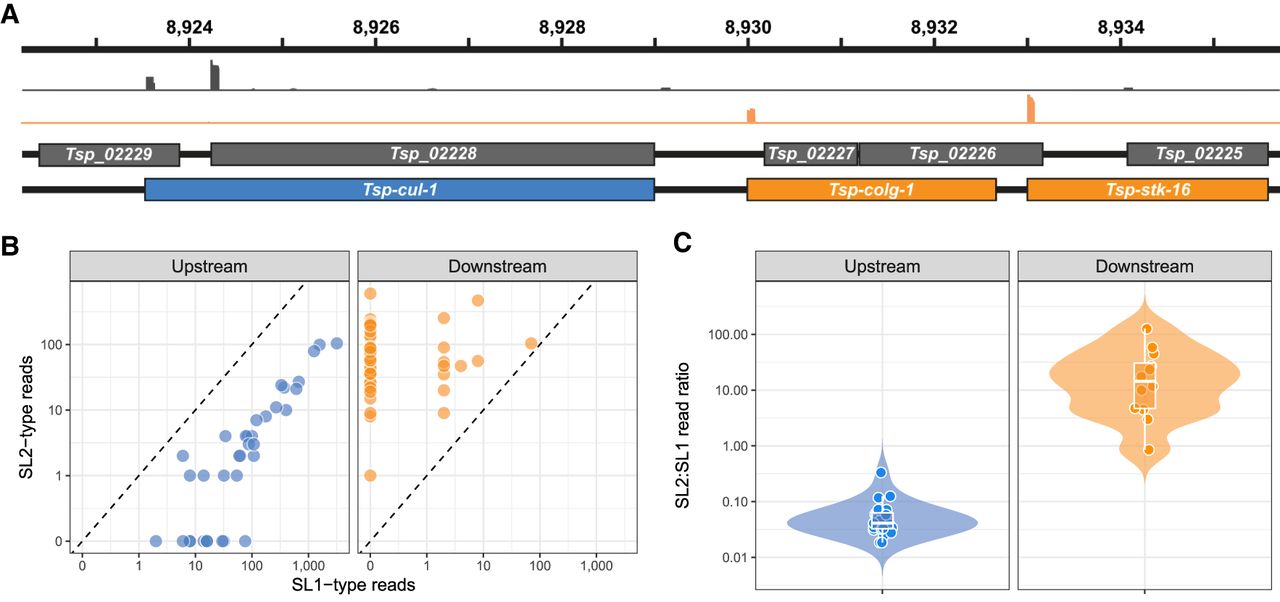
Tsp-SL2, Tsp-SL10, and Tsp-SL12 trans-splicing defines downstream genes in operons. (A) Example of a manually curated T. spiralis operon. Revision of the original gene predictions (represented as dark shaded boxes) shows this to be a three gene operon. Alignment of Tsp-SL-containing reads shows differential usage of spliced leaders, with Tsp-SL2, Tsp-SL10, and Tsp-SL12 containing reads (defined as SL2-type reads, orange peaks) being greatly enriched at the downstream genes. Conversely, all other Tsp-SLs (SL1-type reads, gray peaks) are enriched at upstream genes. Depth for both tracks is scaled to 80. The revised T. spiralis gene annotations are named based on their C. elegans and/or human orthologs. Note that the exon/intron structure of the genes is not shown. Many of the SL1-type reads span an intron in Tsp-cul-1. X-axis indicates distance in kilobases along Scaffold GL622787. (B) Scatter plots of SL1- and SL2-type read counts of trans-splice sites for genes upstream or downstream in 45 manually curated operons. Upstream genes without any Tsp-SL reads are not plotted. (C) Distributions of SL2:SL1 read-count ratios for genes upstream or downstream in operons. Each gene is represented by a dot and distributions are summarized with boxplots and density plots. Only genes with at least one SL1 and SL2 read are plotted.




