


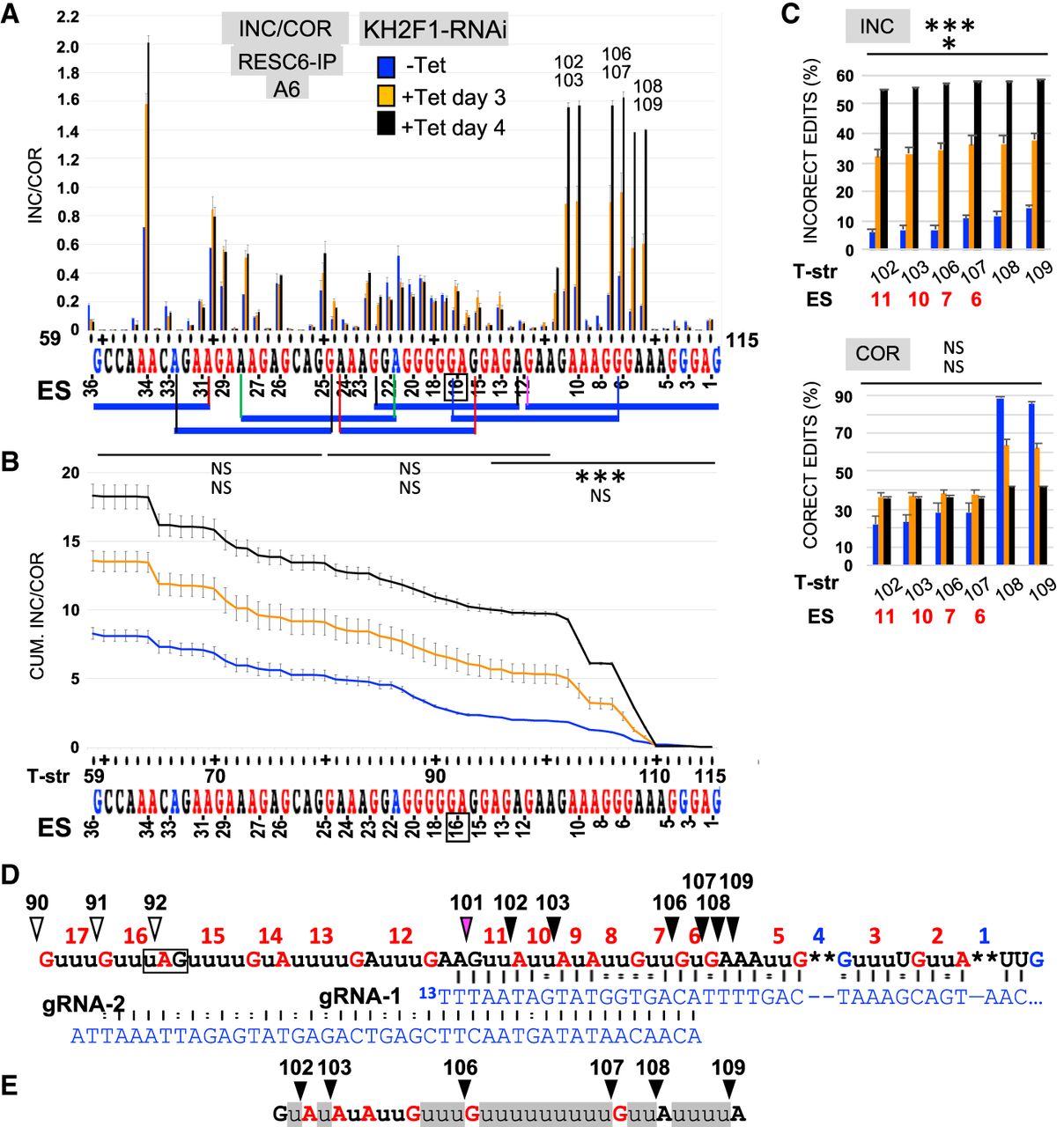
RNA editing accuracy in A6 from RESC6-IPs upon KH2F1–RNAi: (A) Site-by-site, and (B) cumulative analysis spanning T-str positions 59–115 (i.e., including ES1–34). Positions upstream of T-str 59 are omitted because the sequence reads containing edits became too few (or zero) in one or both replicates to calculate Inc/Cor ratio. Positions across 102–109 are marked. (C) Site-by-site percentage of incorrect (Inc; top) and correct (Cor; bottom) editing reads at the positions marked in A. Values and error bars reflect mean of n = 2 +SD independent biological replicates. Sliding window analyses are annotated comparing −Tet to +Tet day 4 (top tier) or +Tet day 3 (bottom tier) in B and C. (D) Alignment of fully edited A6 3′ end sequence to gRNA-1 (3′ portion) and gRNA-2. Color-coded arrowheads indicate high-frequency reads with incorrect editing, as in Figure 3B. The alternative gRNA-1 sequence (gA6-1.alt) in strain Lister (Madina et al. 2014) and a predicted gRNA-2 (m0_306(II)_gA6_v2 [724–766]) in strain EATRO 1125 (Cooper et al. 2019) were used. (E) Predicted sequence including the most frequent sequences with incorrect editing (highlighted in gray) at six positions across T-str 102–109 marked in A and D.




