


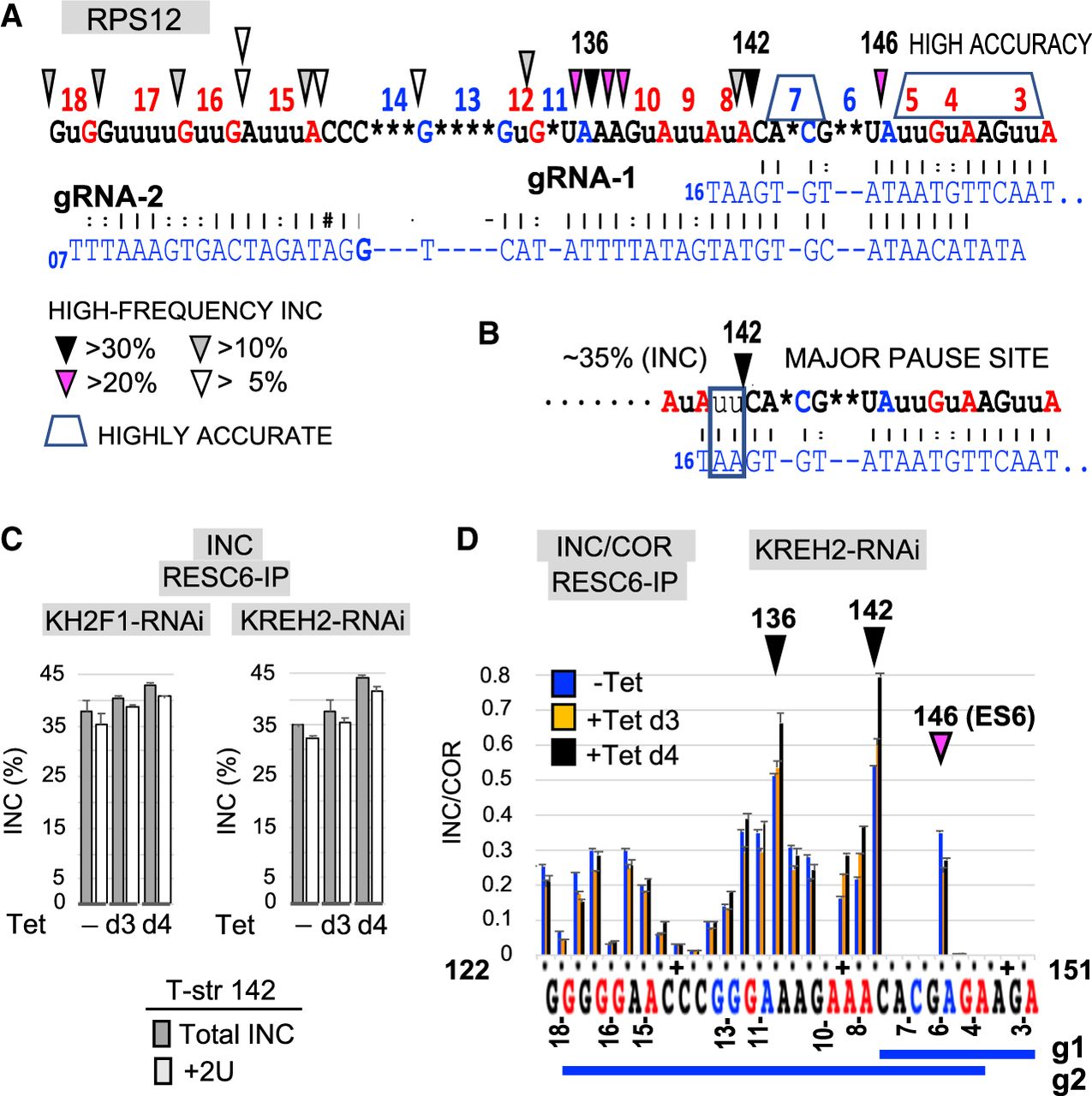
RNA editing at the 3′ end of the RPS12 ORF sequence. (A) Alignment of canonical fully edited RPS12 3′ end transcript sequence to cDNA sequence corresponding to gRNA-1 (3′ portion) and gRNA-2. Color-coded arrowheads indicate high-frequency reads with incorrect editing as in Figure 3C. Trapezoids indicate positions with relatively low Inc/Cor <0.001 or ∼0.001–0.005 that anneal to gRNA-1. Positions T-str 136, 142, and 146 have relatively high Inc/Cor ∼0.3–0.6. The gRNA-1 (single isoform) and gRNA-2 (most frequent isoform) identified in T. brucei EATRO 164 were used (Koslowsky et al. 2013). (B) Alignment of gRNA-1 that may account for a high-frequency event of incorrect editing (∼35% of all reads at position T-str 142, marked by a box). Two adenines in the gRNA 3′ end may direct this event. (C) Frequency of incorrectly edited sequences (Inc) at position T-str 142 in RESC6-IPs upon the indicated RNAi at days 0, 3, and 4 postinduction. The total Inc (all incorrect sequences) and the most frequent incorrectly edited sequence (+2U) at position T-str 142 are plotted. (D) Site-by-site Inc/Cor upon KREH2–RNAi across positions T-str 122–151. Positions T-str 136, 142, and 146 are marked. Blue bars depict gRNA-1 (g1) and gRNA-2 (g2). Values and error bars reflect mean of n = 2 +SD independent biological replicates.




