


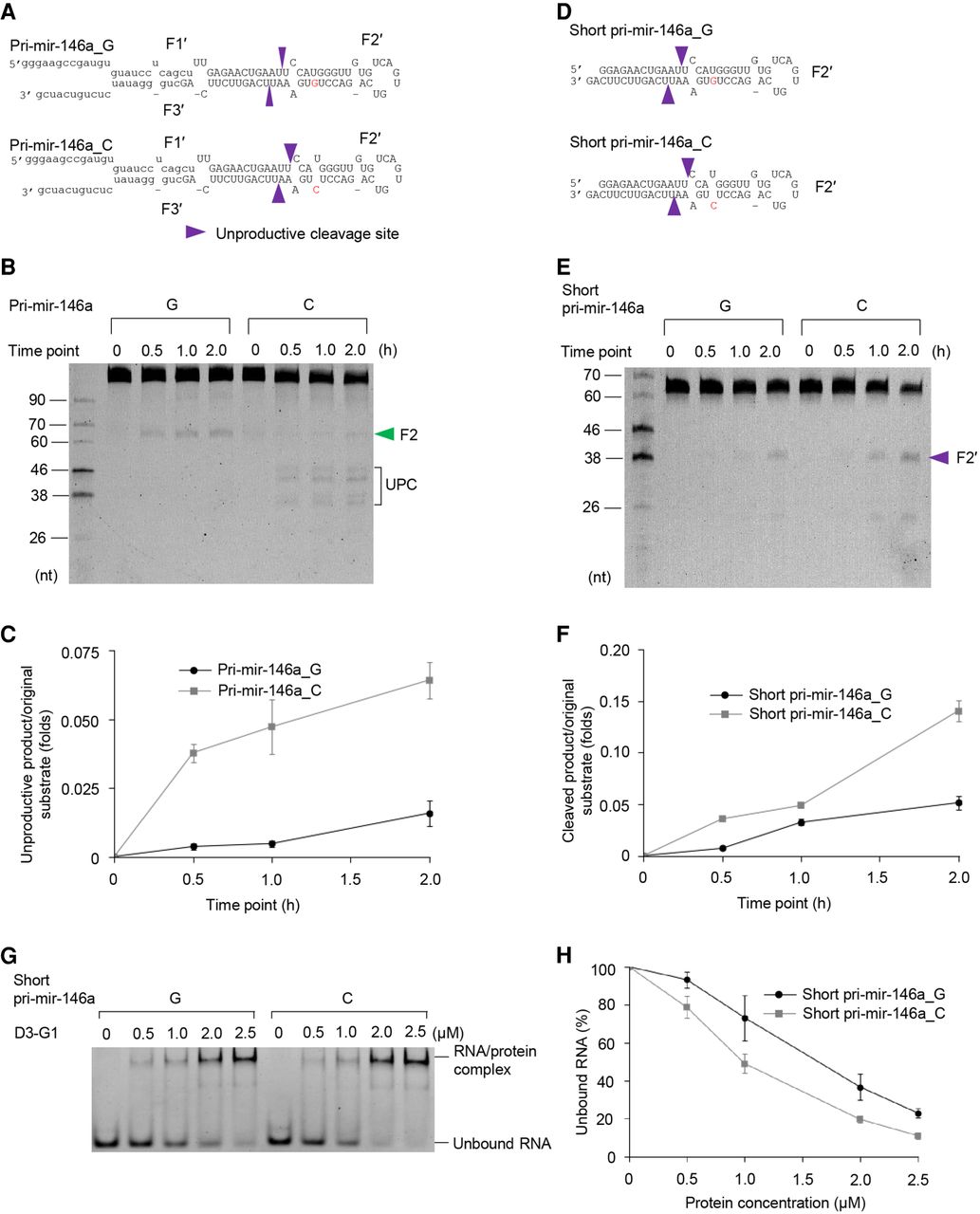
The G/C SNP recruits DROSHA to the apical junction. (A,D) The structures of pri-mir-146a_G and C (A), and short pri-mir-146a_G and C (D). The green and purple arrowheads indicate the productive and unproductive cleavage sites, respectively. (B,E) The cleavage of pri-mir-146a_G and C (B) and short pri-mir-146a_G and C (E) by D3–G1. Five pmol of each RNA was incubated with 15 pmol D3–G1 in 10 µL pri-miRNA processing buffer for 0.5, 1, and 2 h. UPC (in B) indicates the unproductive products. (C,F) The unproductive cleavage of D3–G1 (shown in B and E, respectively) was assessed in three independent experiments. (G) The EMSAs for D3–G1 and short pri-mir-146a_G and C. 1.5 pmol of each RNA was incubated with 5–25 pmol D3–G1 in 10 µL EMSA buffer. (H) Quantification of the EMSA data from G; the results were obtained from three independent experiments.




